


What Is a Trifocal Lens for Cataract Surgery?
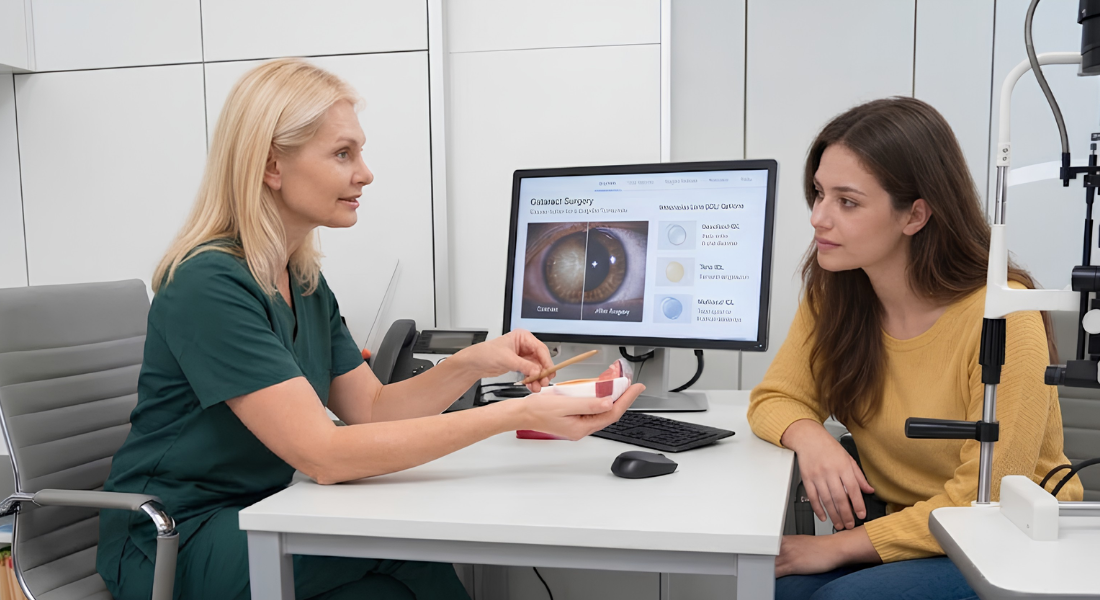
If you are having cataract surgery, a trifocal intraocular lens (IOL) is designed to provide useful vision at distance, intermediate and near ranges. You may therefore need glasses less often for activities such as driving, computer work and reading.
You should know that trifocal lenses can cause halos, glare or starbursts, particularly at night. Your eye health, astigmatism, lifestyle and expectations should all be considered before choosing this type of lens.
What Exactly Is a Trifocal Intraocular Lens?
A trifocal intraocular lens (IOL) is an artificial lens placed inside your eye during cataract surgery. It is designed to provide useful vision at distance, intermediate and near ranges, helping you rely less on glasses.
You may use these ranges for activities such as driving, computer work and reading. The lens does not restore your natural focusing ability, but your brain can adapt to using its different focal ranges.
How Does a Trifocal Lens Work?
A trifocal lens does not change shape like your natural lens once did. Instead, its optical design directs light towards distance, intermediate and near focal ranges, while your brain learns to use the image that is most useful.
You may notice halos, glare or starbursts because light is distributed across several focal points. You should consider these visual effects when deciding whether a trifocal lens suits your needs.
What Does Distance Vision Mean With a Trifocal Lens?
Distance vision with a trifocal lens allows you to see objects several metres away, such as road signs, faces across a room or the television. You may have good distance vision without glasses, although a small amount of prescription or astigmatism can sometimes remain after surgery.
You should know that night driving may be more challenging because halos and glare can affect your vision in low light. Your surgeon should discuss realistic distance-vision expectations with you rather than promising complete freedom from glasses.
Why Is Intermediate Vision Important?
Intermediate vision covers arm’s-length tasks, and trifocal lenses provide a dedicated intermediate range. Working distance varies between lens designs.
- Computer use: Laptop or desktop viewing may be easier without glasses.
- Dashboard viewing: You may see dashboard information more comfortably.
- Kitchen activities: Food preparation and checking ingredients may be easier.
- Shopping and hobbies: Arm’s-length tasks may feel more comfortable.
Tell your surgeon your screen and working distances so the intermediate range can be discussed realistically.
How Good Is Near Vision With a Trifocal Lens?
You may get strong near vision with a trifocal lens for activities such as reading, using your phone or checking labels. Compared with EDOF lenses, trifocal lenses generally provide better unaided near vision.
You should know that lighting, contrast, reading distance and your macular health can affect how well you see small print. You may still prefer glasses for very small print or prolonged reading, so your surgeon should explain what near range your chosen lens is designed to provide.
Can a Trifocal Lens Make You Completely Glasses-Free?

A trifocal lens can reduce your dependence on glasses for distance, computer work and reading. You may still prefer glasses for very small print, detailed tasks or prolonged reading.
You should know that residual prescription or astigmatism can affect your vision after surgery. Your surgeon can discuss realistic expectations and whether a toric trifocal lens may be suitable for you.
Evidence Note
Research suggests that trifocal intraocular lenses can provide useful unaided vision across distance, intermediate and near ranges and can reduce dependence on glasses. However, the trade-off is that optical effects such as halos, glare and starbursts are relatively common, even though only a smaller proportion of patients report finding them severely troublesome.
The exact results vary between lens designs and patients, so outcomes reported for one trifocal lens should not be assumed to apply to every trifocal IOL. Your surgeon should therefore explain the evidence and expected visual characteristics of the specific lens being considered.
What Are Halos, Glare and Starbursts?
You may notice halos, glare or starbursts around bright lights after having a trifocal lens, especially at night. A halo can appear as a ring around a light, while starbursts look like rays and glare can make bright lights feel more intense.
You should know that these effects vary between people and may become less noticeable as you adapt. If you drive regularly at night or are sensitive to glare, you should discuss this with your surgeon before choosing a trifocal lens.
Do Halos and Glare Improve With Time?
You may find that halos and glare become less noticeable during the weeks or months after surgery as your brain adapts to the trifocal lens. However, these effects may not disappear completely, and the amount of adaptation varies between people.
You should know that different trifocal lenses can produce different visual effects. Your surgeon should explain these possible trade-offs before surgery so you have realistic expectations.
Can Trifocal Lenses Reduce Contrast Sensitivity?
You may notice reduced contrast sensitivity with a trifocal lens, particularly in dim lighting or visually demanding situations. Your daytime vision can still be clear, but subtle differences between objects and their background may be harder to see.
You should know that your existing eye health also affects contrast sensitivity. If you already have a condition affecting your visual quality, your surgeon can assess whether a trifocal lens is likely to suit you.
Who Is Most Likely to Suit a Trifocal Lens?
You may be suitable for a trifocal lens if you have healthy eyes and want to reduce your dependence on glasses. Your cornea, retina, macula and optic nerve should be assessed carefully, particularly if you have astigmatism, glaucoma or another eye condition.
You should also consider how comfortable you are with possible halos, glare or changes in contrast. Your surgeon can discuss your eye health, lifestyle and expectations to help determine whether a trifocal lens is appropriate for you.
Who May Not Be an Ideal Candidate?
You may need extra assessment before choosing a trifocal lens if you have conditions such as significant macular disease, glaucoma, severe dry eye or irregular astigmatism. Corneal scarring and previous laser eye surgery can also affect how predictable the results are.
You should know that these conditions do not always rule out a trifocal lens. Your surgeon can assess your eye health and measurements to decide whether the lens is suitable for you.
UK Guidance Note
NICE guideline NG77 states that multifocal intraocular lenses should not be offered to people having cataract surgery. Trifocal lenses are a type of multifocal IOL, and NICE’s March 2026 final scope states that multifocal and EDOF lenses are not available in the NHS for routine care.
Trifocal lenses are therefore more likely to be encountered through private cataract treatment. If you are considering one privately, your surgeon should explain its potential benefits, likelihood of still needing glasses and possible visual effects such as halos, glare and reduced contrast before you make a decision.
Can Trifocal Lenses Correct Astigmatism?
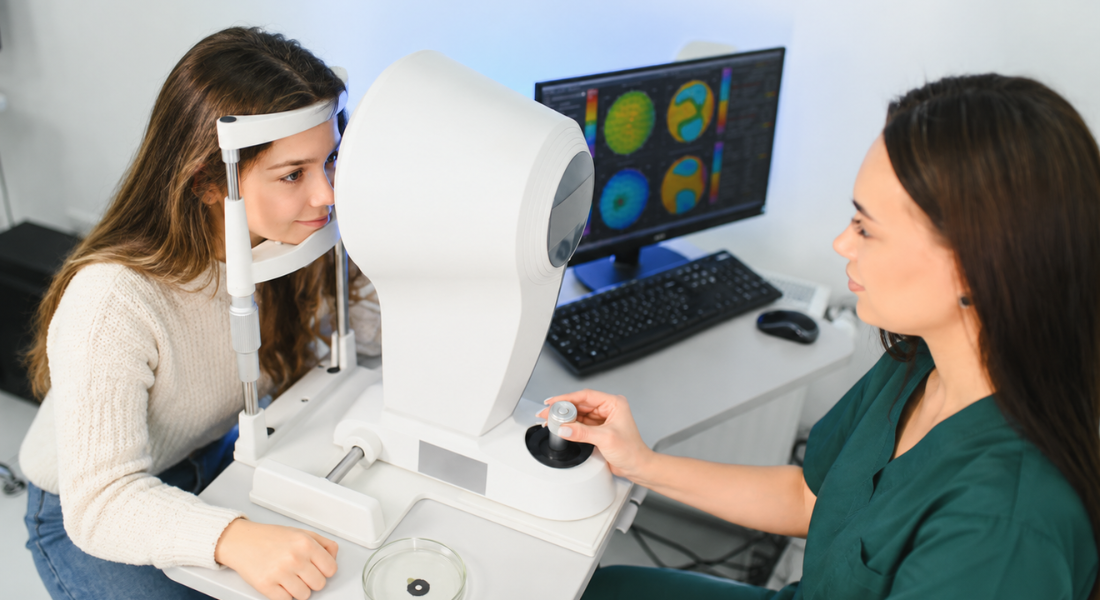
You can have a toric trifocal lens if you have suitable regular astigmatism. It combines the three focusing ranges of a trifocal lens with correction for astigmatism, which can help improve vision at distance, intermediate and near.
You should know that accurate measurements and lens positioning are important for the correction to work effectively. Your surgeon can use detailed corneal measurements to check whether your astigmatism is suitable for a toric trifocal lens.
How Does a Trifocal Lens Differ From a Multifocal Lens?
You may find the terms confusing because a trifocal lens is a type of multifocal lens. A trifocal lens is designed to give you useful vision at distance, intermediate and near, while “multifocal” is a broader term that can include different lens designs.
When you choose a lens, you should focus on how it can meet your visual needs rather than the name alone. You should tell your surgeon which activities matter most to you, so you can understand the near and intermediate vision you are likely to get.
Comparing Monofocal, Trifocal and EDOF Lenses
| Feature | Monofocal Lens | Trifocal Lens | EDOF Lens |
| Main visual aim | Best unaided focus at one principal distance | Useful vision at distance, intermediate and near | Extended range of focus, usually emphasising distance and intermediate vision |
| Distance vision | Usually good when targeted for distance | Can provide good distance vision in suitable eyes | Can provide good distance vision in suitable eyes |
| Intermediate vision | Glasses may be required unless specifically targeted | Designed to provide a dedicated intermediate focal range | Usually an important strength of the design |
| Near vision | Reading glasses are usually needed when targeted for distance | Designed to provide useful unaided near vision | Near performance varies and reading glasses may still be required for small print |
| Dependence on glasses | Usually greater | Generally lower | Generally lower than with a conventional distance-targeted monofocal lens |
| Halos and glare | Usually less common than with presbyopia-correcting multifocal designs | Halos, glare and starbursts can occur | Optical effects can occur and vary between designs |
| Contrast sensitivity | Generally provides straightforward optical quality | Some designs may affect contrast, particularly in difficult lighting | Contrast performance varies between designs |
| Potential suitability | Broad range of cataract patients depending on eye health and refractive target | Carefully selected patients who value a broad range of unaided vision and accept possible visual effects | Selected patients who prioritise distance/intermediate vision and accept that near glasses may still be needed |
How Does a Trifocal Lens Compare With an EDOF Lens?
You may get stronger near vision with a trifocal lens, while an EDOF lens is generally designed to provide a broader range from distance to intermediate vision. You may find an EDOF lens useful for activities such as computer work, cooking and shopping, but you may still need reading glasses for small print.
You should think about which visual tasks matter most to you before choosing between them. If reading without glasses is especially important to you, you may prefer the near range of a trifocal lens, while an EDOF lens may suit you if you are comfortable using reading glasses occasionally.
Research Insight
A 2024 Cochrane review comparing trifocal and extended-depth-of-focus lenses found that distance vision may be similar between the two designs, while trifocal lenses may provide better near vision and reduce the need for near glasses.
However, the overall evidence was considered low certainty because the available studies were relatively small and had limited follow-up. The studies also could not establish a clear difference between trifocal and EDOF lenses in glare and halos. This means lens choice should be based on individual visual priorities rather than assuming that one design is universally better.
How Is a Trifocal Lens Planned Before Surgery?
Before your surgery, you will have detailed eye measurements to help your surgeon calculate the trifocal lens power. Your cornea, astigmatism, retina, macula and tear film may also need checking, particularly if you have dry eye or previous laser eye surgery.
You should tell your surgeon about any previous eye procedures and explain how you use your vision each day. Your reading, screen use and driving needs can help your surgeon choose a lens that better matches your lifestyle and expectations.
Clinical Tip
Before choosing a trifocal lens, think about the distances you use most frequently in everyday life. Tell your surgeon how far you sit from your computer, how close you normally hold a phone or book, whether you drive frequently at night and whether avoiding reading glasses is especially important to you.
These details can be more useful than simply saying you want “good vision at all distances”, because different trifocal lenses have different focal characteristics and no lens can guarantee completely glasses-free vision in every situation.
Are Trifocal Lenses Available Through the NHS?
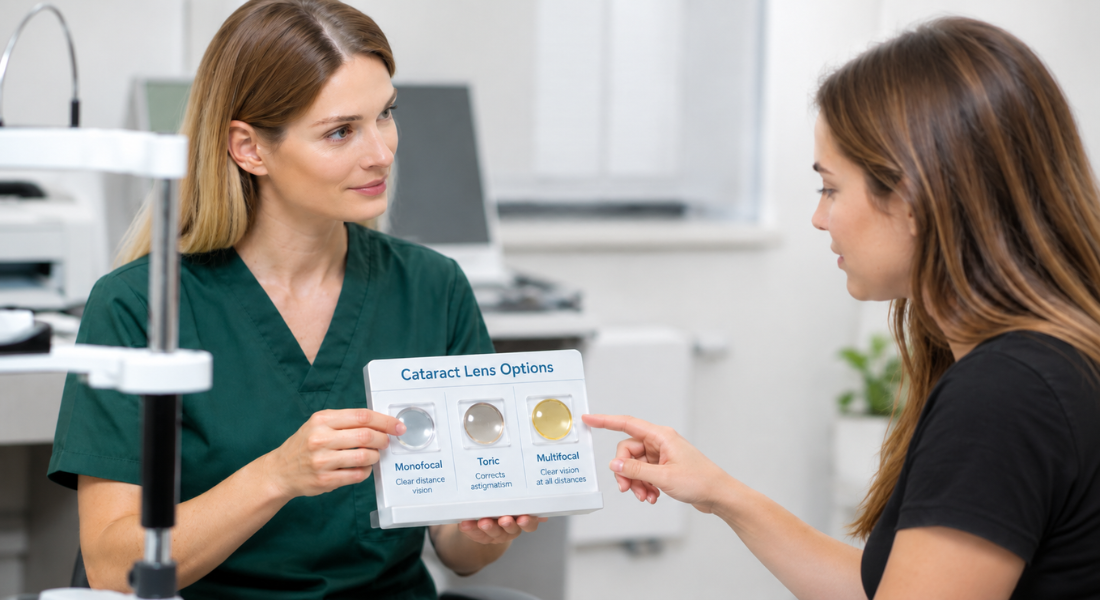
For NHS cataract care in England, NICE guideline NG77 states that multifocal intraocular lenses should not be offered. As trifocal lenses are a type of multifocal IOL, you are therefore more likely to consider a trifocal lens through private cataract surgery.
You should understand that a trifocal lens is not automatically better than a monofocal lens. A monofocal lens can give you excellent vision at one chosen distance, while a trifocal lens may reduce your need for glasses but can also cause halos and glare.
Myth vs Fact
| Myth | Fact |
| A trifocal lens guarantees perfect vision at every distance. | A trifocal lens is designed to provide useful distance, intermediate and near vision, but the quality of vision can vary between ranges and individuals. |
| You will never need glasses after receiving a trifocal lens. | Trifocal lenses can substantially reduce dependence on glasses, but some people still use them for very small print, prolonged close work or other visually demanding tasks. |
| Trifocal lenses restore the natural focusing ability of a young eye. | They do not restore natural accommodation. Their optical design distributes light between several focal ranges to provide useful vision at different distances. |
| Halos and glare always disappear once you adapt to the lens. | These effects may become less noticeable with time, but they can remain noticeable for some people, particularly during night driving. |
| A trifocal lens is automatically better than a monofocal or EDOF lens. | Each lens design has different strengths and trade-offs. The appropriate option depends on your eye health, visual priorities and tolerance of possible optical effects. |
| Everyone having cataract surgery is suitable for a trifocal lens. | Suitability requires assessment of the cornea, macula, retina, optic nerve, ocular surface and other factors that may affect visual quality. |
Key Takeaways
- A trifocal intraocular lens is designed to provide useful vision at distance, intermediate and near ranges after cataract surgery.
- Trifocal lenses can reduce dependence on glasses but cannot guarantee complete spectacle independence.
- Intermediate vision can be useful for activities such as computer work, cooking and viewing a car dashboard.
- Research suggests trifocal lenses may provide stronger unaided near vision than some EDOF lenses, although comparative evidence remains limited.
- Halos, glare and starbursts can occur, particularly in low-light conditions, and may remain noticeable for some people.
- Your cornea, macula, retina, optic nerve, astigmatism and ocular surface should be assessed when considering a trifocal lens.
- A toric trifocal lens may be considered when suitable regular corneal astigmatism also needs correction.
- Night-driving requirements, reading habits, screen use and your tolerance of possible optical effects should form part of the lens-selection discussion.
Frequently Asked Questions
- What is a trifocal lens for cataract surgery?
A trifocal lens is an artificial lens designed to provide useful vision at distance, intermediate and near ranges. You may therefore need glasses less often for activities such as driving, computer work and reading. - Can you see clearly at all distances with a trifocal lens?
A trifocal lens is designed to provide useful vision at distance, intermediate and near ranges, but each distance may not be equally sharp. Your results can also be affected by your eye health, astigmatism and the specific lens design. - Can a trifocal lens make you completely glasses-free?
A trifocal lens can reduce your dependence on glasses, but you may still prefer glasses for very small print, detailed tasks or prolonged reading. Residual prescription or astigmatism can also mean you need glasses sometimes. - Can trifocal lenses cause halos and glare?
Yes, you may notice halos, glare or starbursts around bright lights, particularly at night. These effects may become less noticeable as your brain adapts, although they can remain noticeable for some people. - Do halos and glare improve after trifocal lens surgery?
You may find that halos and glare become less noticeable during the weeks or months after surgery as you adapt to the lens. However, they may not disappear completely, and the amount of adaptation varies between people. - Can trifocal lenses reduce your contrast sensitivity?
Yes, you may notice reduced contrast sensitivity, particularly in dim lighting or visually demanding situations. Your existing eye health can also affect contrast sensitivity and overall visual quality. - Who may be suitable for a trifocal lens?
You may be suitable if your cornea, retina, macula and optic nerve are healthy and you want to reduce your dependence on glasses. Your lifestyle and comfort with possible halos, glare and contrast changes should also be considered. - Can you have a trifocal lens if you have astigmatism?
Yes, a toric trifocal lens may be suitable if you have regular astigmatism. Your surgeon can take detailed measurements to determine whether this type of lens is appropriate for you. - How does a trifocal lens differ from an EDOF lens?
A trifocal lens is designed to provide distance, intermediate and near vision, while an EDOF lens generally extends clear vision from distance towards intermediate ranges. You may still need reading glasses for small print with an EDOF lens. - Are trifocal lenses available through the NHS?
Standard NHS cataract surgery generally uses monofocal lenses. NICE guideline NG77 states that multifocal intraocular lenses should not be offered, and trifocal lenses are a type of multifocal IOL. You are therefore more likely to discuss a trifocal lens as part of private cataract surgery.
Final Thoughts: Is a Trifocal Lens Right for You?
A trifocal lens can provide useful vision at distance, intermediate and near ranges, which may reduce your reliance on glasses after cataract surgery. However, you may experience halos, glare, starbursts or reduced contrast, particularly in low-light conditions, and these effects may not disappear completely.
If you’re considering private cataract surgery in London and want to understand whether a trifocal lens may suit your visual needs, you can contact our team at Eye Clinic London to arrange a consultation.
References:
- Cano-Ortiz, A., Sánchez-Ventosa, Á., Villalba-González, M., González-Cruces, T., Prados-Carmona, J.J., Díaz-Mesa, V., Piñero, D.P. and Villarrubia-Cuadrado, A. (2024) ‘Clinical and patient reported outcomes of an optimized trifocal intraocular lens’, Journal of Clinical Medicine, 13(14), 4133. DOI: 10.3390/jcm13144133. Available at: https://www.mdpi.com/2077-0383/13/14/4133
- Cano-Ortiz, A., Sánchez-Ventosa, Á., González-Cruces, T., Cerdán-Palacios, D., Díaz-Mesa, V., Gallego-Ordóñez, R., Gálvez-Gómez, T., García Parrizas, J.A., Zurera Baena, J. and Villarrubia-Cuadrado, A. (2022) ‘Visual performance, satisfaction, and spectacle independence after implantation of a new hydrophobic trifocal intraocular lens’, Journal of Clinical Medicine, 11(19), 5931. DOI: 10.3390/jcm11195931. Available at: https://www.mdpi.com/2077-0383/11/19/5931
- Tavassoli, S., Ziaei, H., Yadegarfar, M.E., Gokul, A., Kernohan, A., Evans, J.R. and Ziaei, M. (2024) ‘Trifocal versus extended depth of focus (EDOF) intraocular lenses after cataract extraction’, Cochrane Database of Systematic Reviews, 2024(7), CD014891. DOI: 10.1002/14651858.CD014891.pub2. Available at: https://pubmed.ncbi.nlm.nih.gov/38984608/
- Daka, Q., Henein, C., Fang, C.E.H., Mustafa, R., Cocaj, E., Azuara-Blanco, A., Willoughby, C.E., Bokre, D. and Nanavaty, M.A. (2025) ‘Effectiveness of intraocular lenses designed to correct presbyopia after cataract surgery: an overview of systematic reviews’, British Journal of Ophthalmology, 109(12), pp. 1323–1329. DOI: 10.1136/bjo-2025-327363. Available at: https://pubmed.ncbi.nlm.nih.gov/40623803/
- Zhu, D., Karki, S., Dhariwal, M., Soini, E. and Asseburg, C. (2025) ‘Patient-reported outcomes of visual disturbances with a trifocal intraocular lens: A meta-analysis’, Ophthalmology and Therapy, 14(2), pp. 379–390. DOI: 10.1007/s40123-024-01085-9. Available at: https://pmc.ncbi.nlm.nih.gov/articles/PMC11754775/