


What Is an EDOF Lens for Cataract Surgery?

An EDOF lens is designed to give you clear distance and improved intermediate vision after cataract surgery. You may find this useful for computer work, driving and everyday activities.
You may still need reading glasses for small print. EDOF lenses can also cause halos or glare, so you should discuss your visual needs with your surgeon.
How Does an EDOF Lens Work?
An EDOF lens extends your useful range of focus rather than providing one main focusing distance. Its optical design helps you see across a broader range without changing shape like your natural lens.
This can help with distance and intermediate tasks such as driving, computer work or cooking. Results vary between EDOF designs, so discuss your visual priorities with your surgeon.
What Range of Vision Can an EDOF Lens Provide?
An EDOF lens can provide useful distance and intermediate vision for driving, television, computer work and everyday tasks. You may also gain some near vision, although very small print can remain difficult.
Your exact visual range depends on the lens, your prescription and eye health. Good lighting may help with close-up detail, and reading glasses may still be needed.
Evidence Note
Research suggests that EDOF intraocular lenses can improve intermediate vision and reduce dependence on glasses compared with conventional monofocal lenses while maintaining useful distance vision. However, results vary between lens designs, and near vision is generally less predictable than distance or intermediate vision.
A 2019 systematic review and meta-analysis found that EDOF lenses improved intermediate vision and spectacle independence compared with monofocal lenses, but halos were more frequent and contrast sensitivity was lower. Outcomes vary between EDOF designs, so findings from one lens should not automatically be applied to every EDOF lens.
Why Is Intermediate Vision the Main Strength of EDOF Lenses?
Intermediate vision can be particularly useful for the distances you use throughout the day. An EDOF lens is designed to extend your focus towards this range, which may reduce your reliance on glasses for everyday tasks.
- Computer Screens: You may find it easier to view your monitor or laptop at a comfortable working distance.
- Dashboard Details: The extended focus can help you see information on your car dashboard while driving.
- Kitchen Activities: Tasks such as preparing food, reading labels or checking ingredients may be easier at intermediate distances.
- Shopping and Hobbies: You may benefit when looking at items on shelves or carrying out hobbies that involve arm’s-length vision.
You may still need reading glasses for very small print or detailed close-up work. Your usual working distance is therefore worth discussing with your surgeon when considering an EDOF lens.
Will an EDOF Lens Give You Good Reading Vision?

An EDOF lens can give you useful near vision for activities such as reading your phone or a menu in good lighting. However, you may still need reading glasses for very small print or prolonged reading.
You should consider how important glasses-free reading is to you before choosing an EDOF lens. If you want stronger near vision, you may wish to discuss a trifocal lens with your surgeon.
Will You Still Need Glasses With an EDOF Lens?
An EDOF lens can reduce your need for glasses for distance and intermediate activities such as watching television, shopping, cooking and using a computer. You may still need reading glasses for small print, detailed tasks or prolonged reading.
You should also know that a small amount of prescription or astigmatism can remain after surgery. Your surgeon can explain which activities you are most likely to manage without glasses and where you may still need them.
Comparing Monofocal, EDOF and Trifocal Lenses
| Feature | Monofocal Lens | EDOF Lens | Trifocal Lens |
| Main visual aim | Best unaided focus at one principal distance | Extended range of useful focus, usually emphasising distance and intermediate vision | Useful vision at distance, intermediate and near focal ranges |
| Distance vision | Usually good when targeted for distance | Designed to provide useful distance vision | Designed to provide useful distance vision |
| Intermediate vision | Glasses may be needed unless specifically targeted | Usually one of the main strengths of the design | Designed to provide a dedicated intermediate range |
| Near vision | Reading glasses are usually needed when targeted for distance | Some useful near vision may be available, but reading glasses are often still required | Generally stronger unaided near vision than EDOF designs in comparative studies |
| Dependence on glasses | Usually greater | Can be reduced, particularly for distance and intermediate tasks | Can be reduced across a broader range of distances |
| Halos and glare | Generally less likely with conventional monofocal optics | Can occur and vary considerably between lens designs | Can occur, particularly in low-light conditions |
| Contrast and night vision | Generally straightforward optical performance | Performance varies according to lens design | May involve optical trade-offs, particularly in difficult lighting |
| Typical priority | Clear vision at one chosen distance with acceptance of glasses elsewhere | Distance and intermediate activities with acceptance that near glasses may still be needed | Broad spectacle independence including stronger near vision |
How Does an EDOF Lens Compare With a Monofocal Lens?
A monofocal lens gives you clear vision at one main distance, while an EDOF lens aims to extend your focus into the intermediate range. You may therefore need fewer glasses for activities such as computer work with an EDOF lens.
You should know that monofocal lenses can offer strong contrast with fewer optical effects. EDOF lenses may give you a wider range of vision but can cause halos or glare, so your surgeon can help you understand which option suits your needs.
How Does an EDOF Lens Differ From a Multifocal or Trifocal Lens?
An EDOF lens is designed to extend your focus, mainly from distance to intermediate vision. A trifocal lens provides you with separate distance, intermediate and near focal ranges, so you may get stronger close-reading vision.
You may therefore need reading glasses more often with an EDOF lens. Both EDOF and trifocal lenses can cause halos or glare, and direct comparisons have not consistently shown a clear difference between them. Your preferred activities and viewing distances should guide your discussion with your surgeon.
Research Insight
Comparisons between EDOF and trifocal lenses show an important trade-off rather than a clear overall winner. A Cochrane review found that distance vision may be similar, while trifocal lenses may provide better unaided near vision and reduce dependence on reading glasses.
The same review could not establish a meaningful difference in halos and glare between the two groups because the available studies were relatively small. This means that claims about one lens category consistently causing fewer visual effects should be made cautiously and should consider the specific lens designs involved.
Do EDOF Lenses Cause Halos and Glare?
You may notice halos, glare or starbursts after having an EDOF lens, particularly around bright lights at night. These effects can vary depending on your lens design and how your eyes respond.
You should tell your surgeon if you regularly drive at night or work in low light. Your tolerance for these visual effects can help you decide which lens option suits your needs.
What About Contrast Sensitivity and Night Vision?

You may have good vision on an eye chart but still find low-contrast objects harder to see, especially at night. Some EDOF lenses can reduce your contrast sensitivity compared with monofocal lenses, although this varies between lens designs.
You should tell your surgeon if you regularly drive at night or already have an eye condition affecting your vision. Your overall eye health and daily visual needs are important when choosing an EDOF lens.
Who May Be Well Suited to an EDOF Lens?
An EDOF lens may suit you if you have healthy eyes and want clear distance and intermediate vision with less reliance on glasses. You may find it particularly useful if you spend a lot of time using a computer, driving, cooking or shopping.
You should also be comfortable with using reading glasses for small print when needed. Your cornea, macula and retina should be healthy enough to benefit from the lens, and your expectations should match what the lens can realistically provide.
Who May Need More Cautious Assessment?
You may need more careful assessment if you have retinal or macular disease, glaucoma, corneal problems or significant dry eye because these conditions can affect visual quality.
Another eye condition does not automatically rule out an EDOF lens. Your surgeon can assess your eyes and discuss whether an EDOF or monofocal lens better suits your visual needs.
UK Guidance Note
EDOF lenses are not currently available as part of routine NHS cataract care. NICE’s 2026 technology-assessment scope specifically states that multifocal and extended-depth-of-focus lenses are outside routine NHS provision.
You are therefore more likely to encounter an EDOF lens when considering private cataract treatment. Your surgeon should explain the expected visual range, likelihood of still needing reading glasses, possible optical effects and suitable alternatives before you decide whether this type of lens matches your priorities.
Can You Have a Toric EDOF Lens for Astigmatism?
You may be able to have a toric EDOF lens if you have regular corneal astigmatism. It is designed to reduce suitable corneal astigmatism while also extending your range of focus.
Your surgeon will measure your cornea carefully to check whether this option suits you. Accurate positioning is important, as rotation of the lens can reduce your astigmatism correction and affect your vision.
Why Are Accurate Measurements So Important With EDOF Lenses?
Before your cataract surgery, your eye will be carefully measured to calculate the correct EDOF lens power. Your eye length, corneal shape and tear film can all affect how accurate these measurements are.
You should know that even precise measurements cannot guarantee a perfect result. If you have dry eye, your surgeon may treat it before taking your final measurements to help improve the reliability of those measurements.
Clinical Tip
Before choosing an EDOF lens, measure the distances you use in everyday life. Consider how far you sit from your desktop or laptop screen, how close you hold your phone and whether activities such as night driving or reading small print are particularly important to you.
Tell your surgeon these actual working distances rather than simply asking for “good near and distance vision”. Different EDOF lenses provide different functional ranges, and matching the lens to your everyday visual priorities can help you develop more realistic expectations.
What If You Have Previously Had Laser Eye Surgery?
You should tell your surgeon if you have previously had LASIK, LASEK, PRK or another laser eye procedure. Previous surgery changes your corneal shape, which can make your EDOF lens power more difficult to calculate accurately.
You may still be suitable for an EDOF lens after laser eye surgery, but you should understand that the result can be less predictable. Your surgeon may need additional measurements and can discuss your expected outcome with you.
How Do You Decide Whether an EDOF Lens Is Right for You?
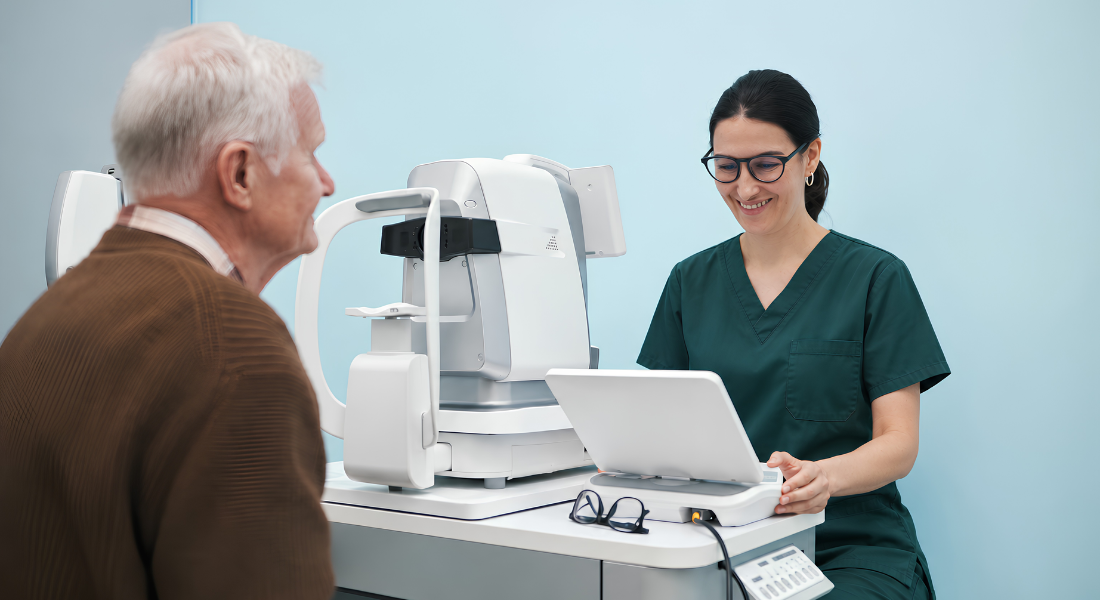
You should start by thinking about the activities you want to do without glasses, such as driving, using a computer or reading. An EDOF lens may suit you if distance and intermediate vision are most important and you are comfortable using reading glasses when needed.
You should also consider your eye health, astigmatism and tolerance for halos or glare. Your surgeon can discuss your lifestyle and expectations with you to help you understand whether an EDOF lens is suitable.
Myth vs Fact
| Myth | Fact |
| An EDOF lens gives perfect vision at every distance. | EDOF lenses are designed to extend the useful range of focus, usually with their greatest benefit at distance and intermediate ranges. Near glasses may still be needed. |
| All EDOF lenses work in exactly the same way. | EDOF is a broad category containing different optical designs, so visual range and optical effects can vary between individual lenses. |
| You will never need reading glasses after receiving an EDOF lens. | Some people achieve useful functional near vision, but small print and prolonged close work commonly still require reading glasses. |
| EDOF lenses never cause halos or glare. | Halos, glare and starbursts can occur. Their frequency and severity vary according to the lens design and the individual patient. |
| EDOF lenses always cause fewer halos than trifocal lenses. | Some evidence suggests EDOF designs may reduce dysphotopsia compared with multifocal lenses generally, but direct EDOF-versus-trifocal studies have not consistently demonstrated a clear difference. |
| An EDOF lens is automatically better than a monofocal lens. | The designs serve different priorities. A monofocal lens offers one principal focal target, while an EDOF lens aims to increase functional range but may involve additional optical trade-offs. |
| Anyone having cataract surgery can choose an EDOF lens. | Suitability depends on your eye health, corneal measurements, astigmatism, visual priorities and other factors that may affect visual quality. |
Key Takeaways
- EDOF lenses are designed to extend useful focus, typically providing distance and intermediate vision rather than several distinct focal points.
- You may need fewer glasses for computer work and other arm’s-length activities than with a conventional distance-targeted monofocal lens.
- Reading glasses may still be required for small print, prolonged reading or other close tasks.
- EDOF lenses are not all optically identical, so visual range, halos, glare and contrast performance can vary between designs.
- Research suggests trifocal lenses may provide stronger unaided near vision than some EDOF lenses, but direct comparisons have not consistently shown clear differences in halos or glare.
- Your cornea, macula, retina, optic nerve and ocular surface should be assessed when considering an EDOF lens.
- Toric EDOF lenses may also correct suitable regular corneal astigmatism, although some residual astigmatism can remain.
- Previous laser eye surgery can make the postoperative refractive result harder to predict.
- EDOF lenses are not currently available for routine NHS cataract care and are more commonly encountered in private practice.
Frequently Asked Questions
- What is an EDOF lens for cataract surgery?
An EDOF lens is an artificial lens designed to extend your range of clear vision, mainly from distance towards intermediate vision. You may find this useful for activities such as driving, computer work and cooking. - Will you still need reading glasses with an EDOF lens?
Yes, you may still need reading glasses for very small print, detailed tasks or prolonged reading. You may have some useful near vision, particularly in good lighting, but close reading is not usually the main strength of an EDOF lens. - Can an EDOF lens improve your computer vision?
Yes, EDOF lenses are designed to provide useful intermediate vision, which can help with computer work and other arm’s-length activities. Your usual screen distance can affect how useful the lens is for you. - Can you get good distance vision with an EDOF lens?
Yes, an EDOF lens can provide strong distance vision alongside improved intermediate vision. Your final result can still be affected by your prescription, astigmatism and overall eye health. - Can EDOF lenses cause halos or glare?
Yes, you may notice halos, glare or starbursts, particularly around bright lights at night. The amount of these effects can vary depending on the specific lens design and how your eyes respond. - Can EDOF lenses affect your night vision or contrast sensitivity?
Some EDOF lenses can reduce contrast sensitivity compared with monofocal lenses. You may therefore find low-contrast objects harder to see, particularly at night or in poor lighting. - How does an EDOF lens compare with a monofocal lens?
A monofocal lens mainly provides clear vision at one chosen distance, while an EDOF lens extends the range of focus towards intermediate vision. You may need fewer glasses for computer work with an EDOF lens, although it can have more optical effects. - How is an EDOF lens different from a trifocal lens?
An EDOF lens mainly extends your focus from distance towards intermediate vision, while a trifocal lens provides separate distance, intermediate and near focal ranges. You may therefore need reading glasses more often with an EDOF lens. - Can you have a toric EDOF lens if you have astigmatism?
Yes, a toric EDOF lens may be suitable if you have regular corneal astigmatism. Your surgeon will measure your cornea and assess whether this option may help reduce your astigmatism while extending your range of focus. - How do you decide whether an EDOF lens is right for you?
You should consider which activities you want to do without glasses, such as driving, computer work or cooking. Your surgeon can also consider your eye health, astigmatism, previous laser eye surgery and tolerance for halos or glare when discussing whether an EDOF lens suits you.
Final Thoughts: Choosing the Right EDOF Lens for Cataract Surgery
An EDOF lens can give you clear distance and useful intermediate vision, which may reduce your reliance on glasses for activities such as driving, computer work and everyday tasks. However, you may still need reading glasses for small print, and you may notice visual effects such as halos or glare.
If you’re considering private cataract surgery in London and want to understand whether an EDOF lens may suit your visual needs, you can contact Eye Clinic London to arrange a consultation.
References:
- Kim, D.Y., Park, E.S.Y., Park, H., Kim, B.Y., Jun, I., Seo, K.Y., Elsheikh, A. and Kim, T.-i. (2025) ‘Comparative outcomes of the next-generation extended depth-of-focus intraocular lens and enhanced monofocal intraocular lens in cataract surgery’, Journal of Clinical Medicine, 14(14), 4967. DOI: 10.3390/jcm14144967. Available at: https://www.mdpi.com/2077-0383/14/14/4967
- Karam, M., Alkhowaiter, N., Alkhabbaz, A., Aldubaikhi, A., Alsaif, A., Shareef, E., Alazaz, R., Alotaibi, A., Koaik, M. and Jabbour, S. (2023) ‘Extended depth of focus versus trifocal for intraocular lens implantation: An updated systematic review and meta-analysis’, American Journal of Ophthalmology, 251, pp. 52–70. DOI: 10.1016/j.ajo.2023.01.024. Available at: https://www.sciencedirect.com/science/article/pii/S0002939423000405
- Tavassoli, S., Ziaei, H., Yadegarfar, M.E., Gokul, A., Kernohan, A., Evans, J.R. and Ziaei, M. (2024) ‘Trifocal versus extended depth of focus (EDOF) intraocular lenses after cataract extraction’, Cochrane Database of Systematic Reviews, 2024(7), CD014891. DOI: 10.1002/14651858.CD014891.pub2. Available at: https://pubmed.ncbi.nlm.nih.gov/38984608/
- Liu, J., Dong, Y. and Wang, Y. (2019) ‘Efficacy and safety of extended depth of focus intraocular lenses in cataract surgery: a systematic review and meta-analysis’, BMC Ophthalmology, 19, 198. DOI: 10.1186/s12886-019-1204-0. Available at: https://pmc.ncbi.nlm.nih.gov/articles/PMC6719364/
- Than, J. and Barsam, A. (2022) ‘Lens’, in Sundaram, V. et al. (eds.) Training in Ophthalmology, 3rd edn, pp. 121–156. Oxford University Press. DOI: 10.1093/med/9780198871590.003.0003. Available at: https://academic.oup.com/book/43958/chapter-abstract/369602472