


What Is a Toric ICL and Who Is It Suitable For?
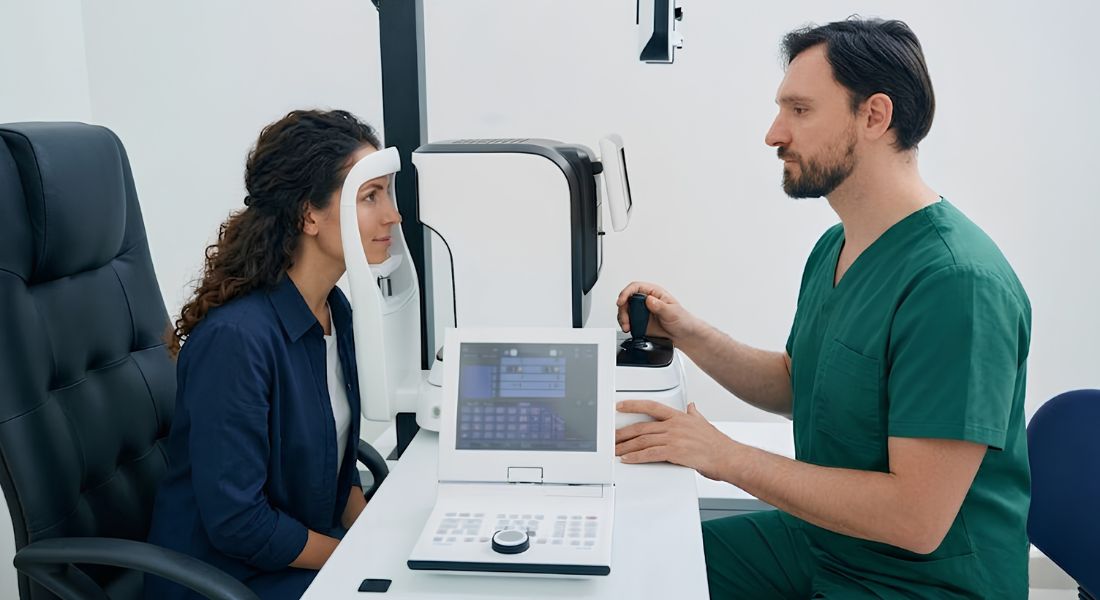
If you have astigmatism as well as short-sightedness, a toric ICL may be able to correct both parts of your prescription. Unlike a standard ICL, it has a specialised design that needs to be positioned at a specific orientation inside your eye to correct the astigmatism accurately.
Your surgeon will take detailed measurements of your eyes and assess your prescription before deciding whether a toric ICL is suitable for you. It may be considered if you have moderate or high short-sightedness or corneal characteristics that make laser treatment less suitable, but having astigmatism alone does not automatically mean it is the right option for you.
What Is a Toric ICL?
A toric ICL is an implantable lens designed to correct astigmatism as well as short-sightedness. It is placed inside your eye, behind the iris and in front of your natural lens, so your natural lens remains in place.
Unlike a standard ICL, a toric ICL has a specialised design with cylindrical power to correct astigmatism at a specific axis. Your surgeon carefully positions the lens based on your eye measurements, and once in place, the lens is designed to remain in your eye long term and does not require daily removal or cleaning, although it can be surgically removed or replaced if clinically necessary.
What Exactly Is Astigmatism?
Astigmatism is a refractive error caused by differences in the curvature or focusing power of your eye. It can make your vision blurred or distorted because light does not focus into one sharp point on the retina. You may notice that fine details, straight edges or lights appear less clear than you would like.
Your glasses prescription records astigmatism using a cylinder value and an axis. The cylinder shows how much correction you need, while the axis shows its orientation. This becomes especially important with a toric ICL, as the lens needs to align correctly with the astigmatism in your eye and may be considered when you are also short-sighted.
How Does a Toric ICL Correct Astigmatism?
A toric ICL corrects your vision by adding optical power inside your eye rather than reshaping your cornea. Its design provides different powers in different directions, helping correct both your short-sightedness and astigmatism.
Your surgeon calculates the required axis using detailed eye measurements and carefully positions the lens at the planned orientation. Once in place, the toric ICL remains behind your iris and in front of your natural lens, so your corneal tissue does not need to be removed.
How Is a Toric ICL Different From a Standard ICL?
A standard ICL mainly provides spherical correction for short-sightedness, while a toric ICL combines spherical and cylindrical correction. This means a toric ICL can address both your short-sightedness and astigmatism in the same lens.
The main difference is that a toric ICL must be carefully aligned with the axis of your astigmatism. Your surgeon uses detailed measurements to position the lens correctly, helping you achieve the intended visual correction.
Standard ICL vs Toric ICL
| Feature | Standard ICL | Toric ICL |
| Main correction | Primarily spherical short-sightedness | Short-sightedness plus astigmatism |
| Cylindrical power | No dedicated toric correction | Yes |
| Axis alignment | No toric axis alignment required | Must be aligned with the planned astigmatic axis |
| Rotation | Less relevant to refractive cylinder | Rotation can reduce astigmatism correction |
| Position | Behind the iris and in front of the natural lens | Same location |
| Corneal reshaping | Not required | Not required |
Who May Be Suitable for a Toric ICL?
You may be considered for a toric ICL if you have astigmatism alongside short-sightedness that can be treated with an implantable lens. You generally need a stable prescription and suitable internal eye anatomy, with enough space for the lens to sit safely.
Your surgeon will also assess your cornea, natural lens, retina, optic nerve and overall eye health. You may be considered for a toric ICL with moderate or high short-sightedness, but the exact prescription, age and anatomical requirements vary between lens models and markets.
How Much Astigmatism Can a Toric ICL Correct?
Toric ICLs are available with different cylindrical powers, allowing various levels of astigmatism to be treated. However, the available range can vary depending on the specific lens model, country and regulatory approval.
Your surgeon will assess your prescription, the amount and axis of your astigmatism, and detailed corneal measurements before selecting the lens power. You should not assume that a prescription range listed elsewhere will automatically apply to your eyes, as your suitability depends on your individual measurements.
Evidence Note
Clinical studies show that toric ICLs can provide substantial correction of myopic astigmatism in appropriately selected patients.
A systematic review comparing toric ICL with LASIK found refractive and visual outcomes were generally comparable or favoured toric ICL in the included studies, although longer-term comparative safety data remain important.
Why Are Your Eye Measurements So Important?

Your eye measurements are important because the ICL needs the correct optical power and a suitable fit inside your eye. Your surgeon will assess measurements such as anterior chamber depth and other dimensions to determine the appropriate lens size and position.
With a toric ICL, your astigmatism and its axis also need careful measurement so the lens can be positioned correctly. Your corneal health, including the endothelial cells, will also be checked to help ensure the procedure is planned safely for your individual eyes.
What Happens During a Toric ICL Assessment?
Your toric ICL assessment usually starts with a discussion about your vision, prescription and eye health. Your surgeon will ask about how stable your prescription has been, previous eye problems, contact-lens use, medications and your general health. Your eyes will then be examined and measured, including your prescription, corneal shape, eye pressure and overall eye health.
For a toric ICL, your astigmatism and its axis need particularly accurate measurements to calculate the appropriate lens. If you wear contact lenses, you may need to stop wearing them before certain tests because they can temporarily change your corneal shape. You can also use the consultation to ask why a toric ICL is being considered instead of a standard ICL, laser vision correction or continuing with glasses or contact lenses.
Clinical Tip
Bring previous glasses or contact-lens prescriptions if you have them. Comparing older and current prescriptions can help your surgeon judge whether your vision, including the cylinder and axis, has remained stable.
You can also ask what findings would make your surgeon recommend a different option instead of a toric ICL. This can help you understand not only why you may be suitable, but also when another treatment may be more appropriate.
What Happens During Toric ICL Surgery?
Toric ICL surgery is usually performed using local anaesthetic eye drops, although the exact process can vary between clinics. Your surgeon makes a small opening at the edge of your cornea and inserts the folded lens through it. The ICL then unfolds behind your iris and in front of your natural lens.
With a toric ICL, your surgeon carefully rotates the lens to align its optical axis with your astigmatism. Once correctly positioned, you should not normally be able to see or feel the lens. Your eye will then be checked, and you will receive instructions about eye drops, activities and follow-up appointments.
Why Does the Position of a Toric ICL Matter?
The position of a toric ICL is important because your astigmatism has both a strength and a specific axis. Your surgeon carefully aligns the lens with this planned axis so the cylindrical correction works as intended.
The lens is designed to remain stable, but some rotation can occasionally occur after surgery. If significant rotation affects your vision, your surgeon may assess the lens position and discuss whether repositioning is needed. Your postoperative assessment may therefore include checking the implant if your vision is not as clear as expected.
Research Insight
Toric ICL alignment can influence the amount of residual astigmatism after surgery. In a 2024 prospective study of 59 eyes with low postoperative vault, the mean absolute lens rotation was about 4.5° at six months, and greater rotation was associated with more residual astigmatism.
The study involved a specific low-vault group, so its rotation rate should not be assumed to apply to every toric ICL patient.
A separate 2024 matched retrospective study involving 646 eyes found less rotation with vertical than horizontal implantation. Because patients were not randomised, this finding should not be taken to mean that one implantation orientation is best for every patient.
What Is Recovery Like After Toric ICL Surgery?

Your vision may improve quickly after toric ICL surgery, but your eyes can take some time to settle. You may initially notice hazy or fluctuating vision, mild discomfort, light sensitivity or watering. Your clinic will usually prescribe eye drops, which you should use as instructed.
Follow-up appointments allow your surgeon to check your vision, eye pressure and the position of the lens. With a toric ICL, they may also check that the lens remains correctly aligned with the intended axis. You may need to avoid rubbing your eyes, swimming and strenuous activities temporarily, and your surgeon will advise when you can return to normal activities.
Will a Toric ICL Completely Remove Your Astigmatism?
The aim of toric ICL surgery is to significantly reduce your astigmatism and other refractive errors being treated. However, no refractive procedure can guarantee a completely zero prescription, so you may have a small amount of residual short-sightedness or astigmatism. Your measurements, lens calculation, positioning and individual healing can all influence the final result.
If you have a small residual prescription that does not affect your daily activities, you may not need further treatment. If your vision is less clear than expected, your surgeon may check your prescription, corneal measurements and the position of the toric ICL. Further treatment may sometimes be considered depending on the cause and amount of residual error.
How Does a Toric ICL Compare With Laser Treatment for Astigmatism?
Laser vision correction reshapes your cornea to correct astigmatism, while a toric ICL adds corrective optical power inside your eye without removing central corneal tissue. Your corneal thickness, shape and prescription can influence which approach may be suitable for you. ICL may be considered when your prescription is outside the range considered suitable for laser treatment.
However, a toric ICL is not automatically the right option for everyone. ICL surgery takes place inside your eye and requires suitable eye anatomy, while laser treatment has different requirements and risks. Your surgeon will assess your eyes and prescription before discussing which options may be appropriate.
What Are the Risks and Considerations With a Toric ICL?
Toric ICL surgery is performed inside the eye, so it has specific risks that should be discussed before treatment. Your surgeon will assess your eye health and explain how these risks may apply to you.
- Eye pressure changes: Pressure inside the eye can sometimes increase after surgery.
- Lens-related complications: The ICL may occasionally need repositioning, replacement or removal.
- Infection or inflammation: As with other surgery inside the eye, infection or inflammation can occur, although serious infection after ICL implantation is uncommon.
- Corneal endothelial health: The cells lining the inner surface of your cornea are assessed before surgery and may need monitoring over time.
- Cataract risk: Cataract formation is a recognised potential complication of ICL surgery. Reported complication rates with newer central-port ICLs are generally low, although longer-term monitoring remains important.
- Residual astigmatism: Some short-sightedness or astigmatism may remain if the lens position or healing differs from expected.
Follow-up allows your surgeon to monitor your vision, lens position and vault, eye pressure, natural lens and corneal health as appropriate.
Can a Toric ICL Be Removed or Replaced?
A toric ICL can usually be surgically removed or, in suitable circumstances, replaced with a different lens. If you have concerns about the lens size, position or refractive result, your surgeon may consider removal or replacement. Unlike laser treatment, an ICL does not permanently reshape your cornea, so your corneal tissue remains largely unchanged.
However, calling an ICL “reversible” does not mean you can simply undo the procedure without further surgery. You would need another operation inside your eye, with its own risks and considerations. Your eyes will also continue to change with age, so an ICL does not prevent presbyopia, cataracts or other age-related changes.
UK Guidance Note
Royal College of Ophthalmologists standards say you should receive clear information about the procedure, suitability, benefits, risks and alternatives before deciding on refractive surgery.
They also recommend a minimum one-week cooling-off period between your surgeon’s treatment recommendation and surgery, giving you time to consider your options and ask further questions.
How Will Your Surgeon Decide Whether You Need a Toric ICL?

Your surgeon will first assess whether ICL surgery is suitable for your eyes, considering your age, prescription stability, eye health and the space available inside your eye. They will also check your cornea, natural lens, retina and other eye structures. Your astigmatism, including its cylinder and axis, will then be measured to determine whether a toric lens is appropriate for you.
Your lifestyle and visual needs can also be discussed, including activities such as night driving, sport and computer use. You may also consider alternatives such as a standard ICL, laser vision correction, contact lenses or glasses. Your surgeon’s recommendation should be based on your complete eye assessment rather than your astigmatism alone.
Myth vs Fact
| Myth | Fact |
| Everyone with astigmatism needs a toric ICL. | Suitability also depends on myopia, eye anatomy and overall eye health. |
| A toric ICL reshapes your cornea. | It corrects vision by adding optical power inside the eye. |
| Lens position does not matter once surgery is complete. | Correct toric-axis alignment is important for astigmatism correction. |
| Toric ICL guarantees a zero prescription. | Some residual astigmatism or myopia can remain. |
| An ICL is completely reversible. | The lens can usually be removed or exchanged, but this requires another operation. |
| Toric ICL prevents future age-related eye changes. | Presbyopia, cataracts and other changes can still develop with age. |
Key Takeaways
- A toric ICL is designed to correct short-sightedness and astigmatism together.
- Unlike laser treatment, it does not rely on removing central corneal tissue.
- Accurate cylinder and axis measurements are important before surgery.
- Correct lens alignment helps achieve the intended astigmatism correction.
- Rotation can occasionally cause residual astigmatism and may require reassessment or repositioning.
- Suitable internal eye anatomy and endothelial cell health are important for ICL eligibility.
- Complete freedom from glasses cannot be guaranteed.
- Regular postoperative follow-up remains important.
Frequently Asked Questions
- What is a toric ICL?
A toric ICL is an implantable lens designed to correct short-sightedness and astigmatism. It contains cylindrical power to address the astigmatic part of your prescription. The lens is placed behind your iris and in front of your natural lens. - How does a toric ICL correct astigmatism?
A toric ICL provides different optical powers in different directions to correct astigmatism. Your surgeon calculates the required axis from detailed eye measurements. The lens is then positioned at the planned orientation inside your eye. - What is the difference between a toric ICL and a standard ICL?
A standard ICL mainly provides spherical correction for short-sightedness. A toric ICL combines spherical and cylindrical correction, allowing it to address astigmatism as well. It also needs careful alignment with the axis of your astigmatism. - Who may be suitable for a toric ICL?
You may be considered if you have short-sightedness and astigmatism and have suitable eye anatomy. Your prescription generally needs to be stable, and your surgeon will assess your cornea, natural lens, retina and overall eye health. Astigmatism alone does not automatically make you suitable. - How much astigmatism can a toric ICL correct?
Toric ICLs are available with different cylindrical powers. The available range depends on the specific lens model, country and regulatory approval. Your surgeon will assess your prescription, astigmatism and eye measurements before selecting the appropriate lens. - Why are eye measurements important before toric ICL surgery?
Detailed measurements help your surgeon determine the correct lens power, size and position. Your astigmatism and its axis also need to be measured accurately so the lens can be aligned correctly. Your corneal health and other eye structures will also be assessed. - Why does the position of a toric ICL matter?
A toric ICL needs to align with the planned axis of your astigmatism for the cylindrical correction to work properly. The lens is designed to remain stable, although some rotation can occasionally occur. Significant rotation may affect your vision and could require repositioning. - What is recovery like after toric ICL surgery?
Your vision may improve quickly, although some haziness, fluctuation, mild discomfort or light sensitivity can occur initially. You will usually need prescribed eye drops and follow-up appointments. Your surgeon will check your vision, eye pressure and the position of the lens during recovery. - Will a toric ICL completely remove your astigmatism?
The aim is to significantly reduce your astigmatism and other refractive errors being treated. However, a completely zero prescription cannot be guaranteed, and some residual astigmatism or short-sightedness may remain. Your surgeon can assess any residual prescription if your vision is not as clear as expected. - Can a toric ICL be removed or replaced?
A toric ICL can usually be surgically removed or, where appropriate, replaced with another lens. However, removal requires another operation inside your eye and has its own risks. Your surgeon will consider the lens position, size and refractive result before recommending further surgery.
Final Thoughts: Understanding Toric ICL Treatment
A toric ICL can correct both short-sightedness and astigmatism without reshaping your cornea. Your prescription, eye measurements, astigmatism, eye health and internal eye anatomy all need to be assessed to determine whether a toric ICL is suitable for you.
If you are considering ICL surgery in London, you can contact Eye Clinic London to discuss your prescription, treatment options and arrange a consultation with one of our specialists.
References:
- Goes, S. and Delbeke, H. (2022) ‘Posterior chamber toric implantable collamer lenses vs LASIK for myopia and astigmatism: systematic review’, Journal of Cataract & Refractive Surgery, 48(10), pp. 1204–1210. Available at: https://pubmed.ncbi.nlm.nih.gov/36179351/
- Wannapanich, T., Kasetsuwan, N. and Reinprayoon, U. (2023) ‘Intraocular Implantable Collamer Lens with a Central Hole Implantation: Safety, Efficacy, and Patient Outcomes’, Clinical Ophthalmology, 17, pp. 969–980. Available at: https://pmc.ncbi.nlm.nih.gov/articles/PMC10046236/
- Ye, Y. et al. (2024) ‘Rotational Stability, Footplate Position, and Visual Outcomes of Toric Implantable Collamer Lenses in Eyes With Low Vault’, Journal of Refractive Surgery, 40(7), pp. e460–e467. Available at: https://pubmed.ncbi.nlm.nih.gov/39007814/
- Lee, Y. et al. (2024) ‘Vertical implantable collamer lens as a novel method to increase rotational stability’, PLOS ONE, 19(8), e0308830. Available at: https://pmc.ncbi.nlm.nih.gov/articles/PMC11333007/
- Passaro, M.L. et al. (2026) ‘Potential Harms of Posterior Chamber Phakic IOL: A Systematic Review and Meta-Analysis of Complication Incidence’, American Journal of Ophthalmology, 285, pp. 73–82. Available at: https://www.sciencedirect.com/science/article/pii/S0002939426000413