


What Is a Light Adjustable Lens for Cataract Surgery?
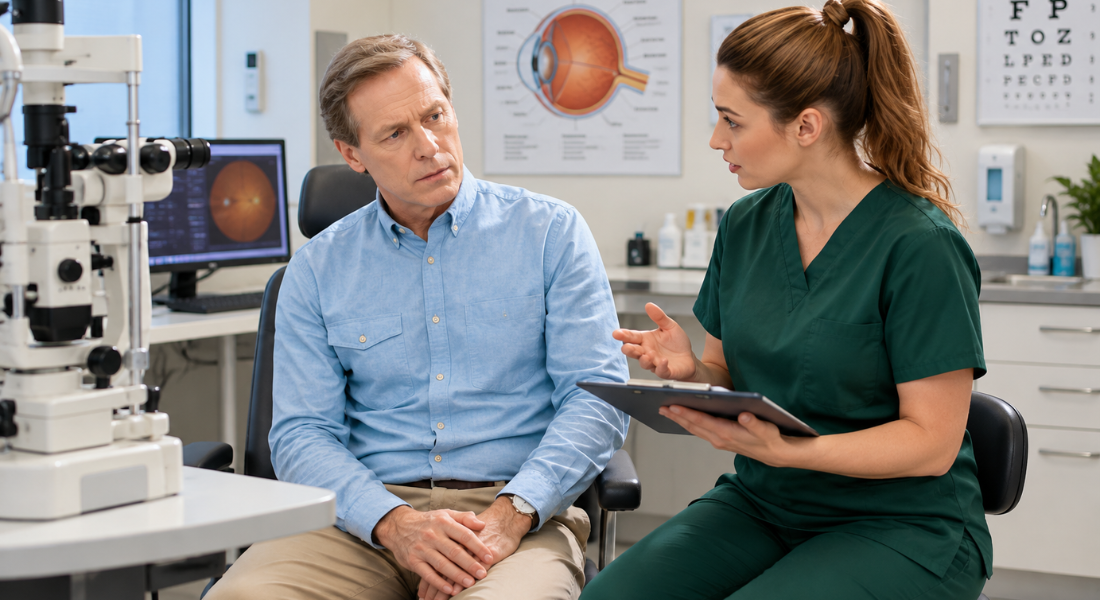
If you’re considering cataract surgery, you may wonder how closely your new lens can match the vision you want. Unlike most intraocular lenses, a Light Adjustable Lens can be fine-tuned after your eye has healed using controlled ultraviolet light treatments.
This flexibility can help refine your visual target, but it requires extra appointments, UV-protective glasses and final lock-in treatments before the prescription is fixed.
What Exactly Is a Light Adjustable Lens?
A Light Adjustable Lens (LAL) is an artificial intraocular lens whose focusing power can be changed after your cataract surgery. The lens contains photosensitive material that responds to controlled ultraviolet light, allowing your surgeon to adjust your prescription once your eye has healed.
You may therefore have your final prescription fine-tuned without another operation if a small amount of short-sightedness, long-sightedness or astigmatism remains. Once you and your surgeon are satisfied with the result, further light treatments lock the lens power permanently.
Why Is Adjustability Useful After Cataract Surgery?
Pre-operative measurements are used to calculate your lens power, but your eye may heal slightly differently from predicted, leaving a small residual prescription.
A Light Adjustable Lens allows this prescription to be refined after healing. Measurements still matter, but the final power can be adjusted according to how your eye settles.
Evidence Note
Clinical evidence suggests postoperative adjustment can improve unaided distance vision in selected patients. In a randomised controlled trial of 40 patients with pre-existing astigmatism, 79% of Light Adjustable Lens eyes achieved 20/20 or better unaided distance vision after lock-in, compared with 33% of eyes receiving a standard monofocal lens.
These figures came from a specific clinical-trial population and should not be treated as a guarantee of an individual result. Your final vision still depends on factors including eye health, healing, the chosen refractive target and successful completion of the adjustment and lock-in process.
How Does Light Actually Change the Lens Power?
The lens contains photosensitive material that responds to controlled light exposure. During an adjustment, a Light Delivery Device applies a precise UV-light pattern to the lens, changing the lens material and altering its optical power. This allows your lens power to be adjusted to better suit your vision needs.
You do not need another operation to make these adjustments. Once your desired prescription is reached, additional light treatment locks the lens power in place, helping you maintain the vision correction achieved.
When Do the Light Treatments Begin?

Adjustments usually start around three weeks after surgery, once your eye has healed and the prescription is stable enough. Your ophthalmologist decides when treatment can begin.
At follow-up visits, your vision and prescription are checked before each adjustment. You and your surgeon can then refine the lens towards your agreed visual target.
How Many Light Treatments Will You Need?
The number of adjustments depends on your postoperative prescription and agreed visual target.
- Initial assessment: Your vision and prescription are checked after your eye has healed to determine whether an adjustment is needed.
- Lens adjustments: You may need around one to three light treatments to fine-tune the lens power according to your postoperative vision.
- Final lock-in: Once you and your surgeon are satisfied with the result, two additional treatments are used to permanently fix the chosen lens power.
- Temporary visual effects: Your pupil is dilated during treatment, so you may experience temporary blurred vision or a pink or red afterimage afterwards. The colour change should usually settle before your next treatment, but let your ophthalmologist know if it persists.
Your surgeon will monitor your vision and decide when each stage should take place.
What Is the Lock-In Process?
Once you are satisfied with your vision, the Light Delivery Device is used for two final lock-in treatments. These permanently secure the chosen lens power.
After the final lock-in, your vision is allowed to settle and the routine adjustment period ends. The lens power can then no longer be fine-tuned.
Why Do You Need Special UV-Protective Glasses?
Before final lock-in, the lens remains sensitive to UV light, so you must wear the supplied UV-protective glasses during waking hours as instructed.
They are usually worn until 24 hours after the final lock-in. Make sure you can follow this requirement before choosing the lens.
Clinical Tip
These glasses are part of the treatment and should be worn exactly as your surgical team advises, indoors and outdoors.
Do not substitute ordinary sunglasses. If the supplied glasses are lost, damaged or not worn as instructed, contact your surgical team for advice.
Can the Lens Correct Astigmatism After Surgery?
Yes. A Light Adjustable Lens can allow your surgeon to fine-tune residual astigmatism after your eye has healed, rather than relying entirely on the correction planned before surgery. You may therefore have the remaining spherical or cylindrical prescription adjusted according to your actual postoperative vision.
You should know that this approach cannot correct every cause of blurred or distorted vision. If you have irregular corneal changes, retinal disease or another eye problem, your final vision may still be limited, so your surgeon will first check whether your remaining blur is suitable for adjustment.
Is the Light Adjustable Lens Helpful After LASIK or Other Laser Eye Surgery?
If you have had LASIK, PRK or LASEK, calculating your lens power for cataract surgery can be more challenging because your cornea has been reshaped. A Light Adjustable Lens allows your surgeon to fine-tune your prescription after your eye has healed.
You do not automatically need an adjustable lens after laser eye surgery. However, you may value the extra opportunity to refine your vision based on your actual postoperative result.
Research Insight
Postoperative adjustability may be particularly useful when lens-power prediction is more difficult, such as after previous LASIK or PRK. A 2024 study of 76 eyes with previous corneal refractive surgery found that 86% finished within ±0.50 dioptres of the intended refractive target, while 74% achieved unaided distance vision of 20/20 or better.
However, this was a retrospective case series rather than a randomised comparison with other modern lens strategies. The results are encouraging, but they do not prove that a Light Adjustable Lens is the best option for every person who has previously had laser eye surgery.
Can You Try Different Visual Targets Before Finalising the Lens?
One benefit of a Light Adjustable Lens is that you can experience your vision before the lens power is permanently fixed. You and your surgeon can then discuss whether distance vision in both eyes or a blended-vision approach better suits your lifestyle.
Blended vision usually means one eye is targeted for distance and the other slightly closer. You should know that this is not suitable for everyone, so your surgeon will consider your work, daily activities and how well you tolerate differences between your eyes.
Is a Light Adjustable Lens the Same as a Multifocal Lens?
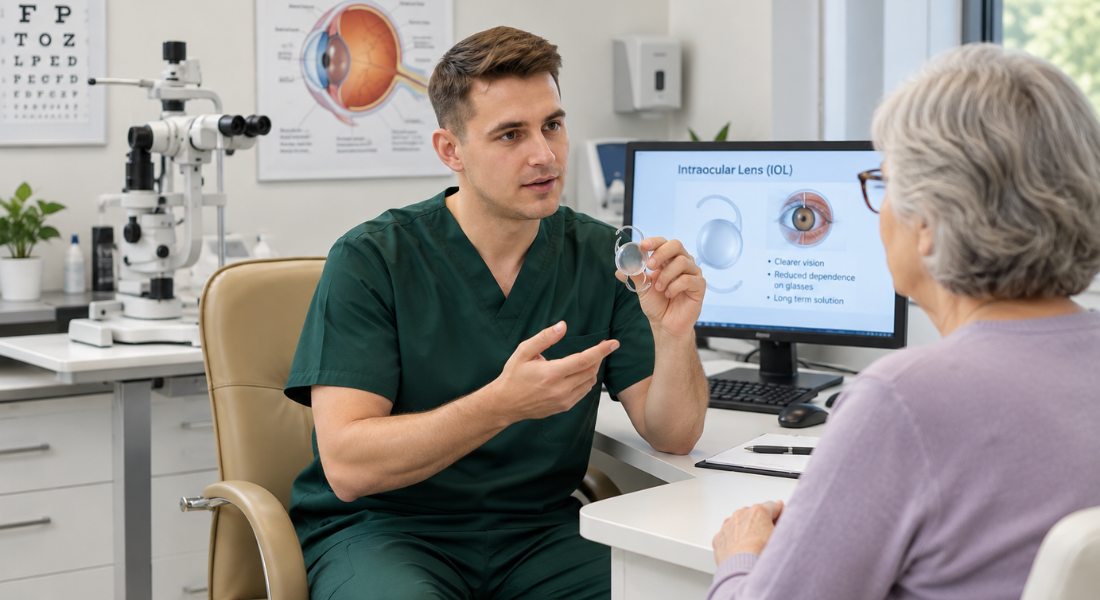
No. A Light Adjustable Lens is defined by its ability to have its power changed after surgery, while a multifocal or trifocal lens is designed to provide focus at different distances. You should not assume that an adjustable lens will give you the same near vision as a trifocal lens.
You may instead discuss a blended-vision approach, where one eye is targeted more towards distance and the other towards intermediate or near tasks. The range of vision you can expect depends on the specific lens and refractive target being considered, so ask your surgeon what the lens being offered is designed to achieve.
How Does It Compare With an Ordinary Monofocal or Toric Lens?
A conventional monofocal or toric lens has a fixed power planned before your cataract surgery, including astigmatism correction with a toric lens. A Light Adjustable Lens allows your surgeon to fine-tune remaining spherical or cylindrical error after your eye has healed.
You should know that a fixed lens can provide excellent results when the planned target is achieved accurately. With an adjustable lens, you have more postoperative customisation, but you will also need extra appointments, UV-protective glasses and the full lock-in process.
Comparing Light Adjustable and Fixed Cataract Lenses
| Feature | Light Adjustable Lens | Fixed Monofocal Lens | Fixed Toric Lens |
| Lens power after implantation | Can be fine-tuned using controlled light treatments before final lock-in | Fixed after implantation | Fixed after implantation |
| Residual spherical prescription | Suitable residual refractive error can be adjusted within the treatment range | Usually managed with glasses, contact lenses or another refractive strategy if significant | Usually managed with glasses or another refractive strategy if significant |
| Astigmatism | Suitable residual cylinder can be adjusted after healing | Does not specifically correct significant corneal astigmatism unless combined with another strategy | Astigmatism correction is built into the lens and depends on accurate power selection and rotational alignment |
| Postoperative appointments | Requires additional refraction, adjustment and lock-in visits | Standard cataract follow-up | Standard cataract follow-up |
| Special UV eyewear | Required during the adjustment period according to the treatment protocol | Not required for lens adjustment | Not required for lens adjustment |
| Finalisation | Usually 1–3 adjustments followed by two lock-in treatments | No postoperative lens-power adjustment | No postoperative lens-power adjustment |
| Main advantage | Allows refractive fine-tuning after the eye has healed | Simpler postoperative pathway | Corrects suitable corneal astigmatism without postoperative light adjustment |
| Main limitation | More visits and strict adherence to the UV-protection/light-treatment pathway | Residual refractive error cannot be altered within the implanted lens | Residual refractive error or toric misalignment may still occur |
Who May Be a Good Candidate for a Light Adjustable Lens?
A Light Adjustable Lens may suit you if postoperative fine-tuning is especially important, including after LASIK or PRK, or if you want to refine residual astigmatism.
Your surgeon will assess your cornea, retina and optic nerve. You must also be able to attend the required visits and follow the UV-protection instructions.
Who May Not Be Suitable for the Treatment?
A Light Adjustable Lens may not be suitable if you take certain medicines that increase sensitivity to ultraviolet light or if you have an eye condition that could limit your final vision. Your surgeon will also need to consider whether you can attend the required adjustment and lock-in appointments and follow the UV-protection instructions throughout treatment.
Give your surgeon a complete list of prescribed medicines, over-the-counter treatments and supplements before treatment. Do not stop or change any medication yourself; your medical team can advise you if a medicine affects whether the Light Adjustable Lens is appropriate for you.
UK Guidance Note
If you are considering a Light Adjustable Lens in the UK, availability will depend on whether your treating centre has the dedicated Light Delivery Device, appropriately trained staff and the required postoperative adjustment pathway.
Because this is a specific device system requiring specialist equipment, postoperative light treatments and UV-protection protocols, availability and eligibility depend on the treating centre. Your ophthalmologist should explain the particular lens version being offered, its regulatory status, treatment schedule, contraindications and required aftercare.
What Are the Disadvantages and Practical Limitations?

You will need more appointments after cataract surgery for vision checks, adjustments and lock-in treatments. You must also wear UV-protective glasses as instructed for several weeks, which may be less convenient than a conventional fixed lens.
You should know that a Light Adjustable Lens cannot guarantee perfect vision, and you may still need glasses for some activities. Once the final lock-in is complete, your chosen lens power is intended to remain permanent rather than adjustable.
How Do You Decide Whether a Light Adjustable Lens Is Right for You?
You should consider whether postoperative fine-tuning is important to you, particularly if you have had laser eye surgery or have specific visual goals. Think about whether you prioritise distance vision, blended vision, reading, screen use or driving.
Your surgeon will assess your eye health, previous surgery, medicines and measurements before recommending a lens. You should also be comfortable wearing UV-protective glasses and attending all adjustment and lock-in appointments, as these are essential parts of the treatment.
Myth vs Fact
| Myth | Fact |
| The surgeon chooses the final prescription before surgery, just like every other lens. | An initial lens power is still selected before surgery, but the Light Adjustable Lens can subsequently be fine-tuned after healing and before final lock-in. |
| The lens can be adjusted forever. | No. There is a limited adjustment period. Once the final lock-in treatments are completed, routine refractive adjustment of the lens is no longer performed. |
| You can use ordinary sunglasses instead of the supplied UV glasses. | The manufacturer specifically requires its UV-protective eyewear during the adjustment period and does not guarantee that other sunglasses provide equivalent protection. |
| The Light Adjustable Lens guarantees perfect vision without glasses. | It can improve refractive accuracy, but it cannot guarantee a particular visual acuity or complete spectacle independence. |
| Everyone who has previously had LASIK should receive a Light Adjustable Lens. | Previous corneal laser surgery can make lens calculations more difficult, and postoperative adjustment may be useful, but suitability still depends on individual eye health and visual goals. |
| It is the same as a multifocal or trifocal lens. | No. Adjustability describes the ability to change refractive power after surgery. Multifocal and trifocal refer to optical designs intended to provide multiple viewing ranges. |
| Medication does not matter because the treatment is applied only to the eye. | Some systemic medicines can increase UV sensitivity or affect retinal safety, so your complete medication list must be reviewed before treatment. |
Key Takeaways
- A Light Adjustable Lens allows suitable residual short-sightedness, long-sightedness and astigmatism to be fine-tuned after cataract surgery.
- Adjustments usually begin only after the eye has healed, typically around three weeks or later.
- The treatment pathway generally involves one to three adjustment treatments followed by two final lock-in treatments.
- You must wear the supplied UV-protective glasses as instructed until 24 hours after the final lock-in.
- Eye disease and certain medicines can affect suitability, so your eye health and full medication list need to be reviewed.
- Once lock-in is complete, routine further adjustment is no longer available, and the lens cannot guarantee perfect vision or complete freedom from glasses.
Frequently Asked Questions
- What is a Light Adjustable Lens for cataract surgery?
A Light Adjustable Lens is an artificial lens whose focusing power can be changed after cataract surgery using controlled ultraviolet light treatments. This allows your surgeon to fine-tune your prescription after your eye has healed. - How does a Light Adjustable Lens work?
The lens contains photosensitive material that responds to controlled ultraviolet light. Your surgeon uses a Light Delivery Device to make precise changes to the lens power without another operation. - When do the light treatments start after cataract surgery?
Light treatments typically begin around three weeks after surgery, once your eye has had time to heal and your prescription has stabilised. Your ophthalmologist will decide when you are ready for treatment. - How many light treatments will you need?
You may need around one to three adjustment treatments, depending on your prescription and visual goals. Once your adjustments are complete, you will then have two lock-in treatments to make the chosen lens power permanent. - Why do you need UV-protective glasses after surgery?
Before the final lock-in, your lens remains sensitive to ultraviolet light. You need to wear the supplied UV-protective glasses during waking hours to prevent unintended changes to your lens power. - Can a Light Adjustable Lens correct astigmatism?
Yes. Your surgeon can use the adjustment process to fine-tune residual spherical or cylindrical prescription after your eye has healed. However, other causes of blurred vision, such as retinal disease or irregular corneal changes, may still limit your vision. - Can you have a Light Adjustable Lens after LASIK, PRK or LASEK?
You may be suitable for one after previous laser eye surgery. Because calculating lens power can be more challenging after LASIK, PRK or LASEK, postoperative adjustment may provide an additional opportunity to fine-tune your prescription. - Can you try different visual targets with a Light Adjustable Lens?
Yes. You may be able to experience your vision before the final lock-in and discuss whether distance vision in both eyes or a blended-vision approach suits you better. - Is a Light Adjustable Lens the same as a multifocal or trifocal lens?
No. A Light Adjustable Lens is defined by its ability to have its power changed after surgery, whereas multifocal and trifocal lenses are designed to provide vision at different distances. A Light Adjustable Lens does not automatically provide the same near vision as a trifocal lens. - Who may be a good candidate for a Light Adjustable Lens?
You may find this option useful if postoperative refractive fine-tuning is particularly important to you, including after previous laser eye surgery or if you have specific visual goals. You also need to be comfortable attending several appointments and following the UV-protection instructions throughout the adjustment period.
Final Thoughts: Choosing a Light Adjustable Lens for Cataract Surgery
A Light Adjustable Lens can fine-tune lens power after cataract surgery, which may be useful if you have specific visual goals or previous laser eye surgery. However, it requires extra appointments, UV-protective glasses and lock-in treatments.
If you’re considering private cataract surgery in London, you can contact Eye Clinic London to discuss whether a Light Adjustable Lens may suit you.
References:
- Vacalebre, M., Frison, R., Corsaro, C., Neri, F., Santoro, A., Conoci, S., Anastasi, E., Curatolo, M.C. and Fazio, E. (2023) ‘Current state of the art and next generation of materials for a customized intraocular lens according to a patient-specific eye power’, Polymers, 15(6), p. 1590. doi: 10.3390/polym15061590. Available at: https://www.mdpi.com/2073-4360/15/6/1590
- Jones, M., Terveen, D.C., Berdahl, J.P., Thompson, V., Kramer, B.A. and Ferguson, T.J. (2024) ‘Clinical outcomes of the light-adjustable lens in eyes with a history of prior corneal refractive surgery’, Journal of Cataract & Refractive Surgery, 50(9), pp. 936–941. doi: 10.1097/j.jcrs.0000000000001481. Available at: https://pubmed.ncbi.nlm.nih.gov/38736178/
- Moshirfar, M., Wagner, W.D., Linn, S.H., Skanchy, D.F., Brown, T.W., Gomez, A.T., Goldberg, J.L., Ronquillo, Y.C. and Hoopes, P.C. Jr (2019) ‘Astigmatic correction with implantation of a light adjustable vs monofocal lens: A single site analysis of a randomized controlled trial’, International Journal of Ophthalmology, 12(7), pp. 1101–1107. doi: 10.18240/ijo.2019.07.08. Available at: https://pmc.ncbi.nlm.nih.gov/articles/PMC6629796/
- Chayet, A., Sandstedt, C., Chang, S., Rhee, P., Tsuchiyama, B., Grubbs, R. and Schwartz, D. (2009) ‘Correction of myopia after cataract surgery with a light-adjustable lens’, Ophthalmology, 116(8), pp. 1432–1435. doi: 10.1016/j.ophtha.2009.02.012. Available at: https://www.sciencedirect.com/science/article/abs/pii/S0161642009001729
- Than, J. and Barsam, A. (2022) ‘Lens’, in Sundaram, V. et al. (eds.) Training in Ophthalmology. 3rd edn. Oxford: Oxford University Press, pp. 121–156. doi: 10.1093/med/9780198871590.003.0003. Available at: https://academic.oup.com/book/43958/chapter-abstract/369602472