

Can Wearable Technology Improve Eye Health?

Wearable devices can collect information about your vision, eye movements, environment or everyday activities while you follow your normal routine. Researchers are investigating whether this information could help your clinician monitor your condition, understand your real-world visual function or identify changes requiring further assessment.
Some wearable devices can already support you if you have sight loss or allow selected visual tests to be completed at home. Many advanced applications, including biomarker-sensing contact lenses and automated disease predictions, remain experimental and cannot replace your professional eye examination.
What Is Wearable Eye Technology?
Your wearable eye technology may include smart glasses, sensor-equipped contact lenses, head-mounted displays, eye trackers or light-monitoring watches. Depending on its purpose, your device may support your everyday vision, measure a specific function or collect research data.
Not every wearable is a medical device or has been clinically validated. You should check whether your device is intended for general wellbeing, visual assistance, research or the diagnosis and monitoring of a medical condition.
Why Is Continuous Monitoring Useful?
Your clinic test provides important information about your eyes at a particular time. Some measurements, symptoms and aspects of your visual function may vary between your appointments.
A suitable wearable may collect repeated information while you complete everyday activities or sleep. Your clinician must still determine whether those measurements are accurate, clinically relevant and sufficiently reliable to influence your care.
Monitoring Your Child’s Outdoor Light Exposure
A wearable light sensor may help you estimate patterns in your child’s outdoor activity and exposure to different light levels. However, a sensor worn on your child’s wrist does not measure the exact amount of light reaching their eyes and may underestimate their true exposure.
Research suggests that longer periods outdoors and exposure to brighter outdoor light may be associated with a lower likelihood of children developing myopia. However, these findings do not prove that a particular wearable, light threshold or duration outdoors will prevent myopia in your child.
Could Wearables Help Prevent Myopia?
Spending more time outdoors may reduce your child’s likelihood of developing myopia or delay its onset. Evidence that outdoor time meaningfully slows the progression of myopia after it has developed is less certain.
Your wearable can encourage or record outdoor activity, but it cannot prevent or treat myopia independently. Your child should continue wearing prescribed glasses or contact lenses and attending appropriate eye examinations and myopia-management reviews.
Can Your Smart Contact Lens Diagnose Glaucoma?
Your smart contact lens cannot diagnose glaucoma independently. An unusual pressure-related profile does not prove that your optic nerve has been damaged, while a normal profile cannot exclude glaucoma or future progression.
Your clinician must assess your optic nerve, visual fields, measured eye pressure, cornea, OCT findings and other risk factors. Your contact-lens result may provide supplementary information only when your device has been appropriately validated and is being used for its intended clinical purpose.
Monitoring Your Pressure-Related Eye Patterns
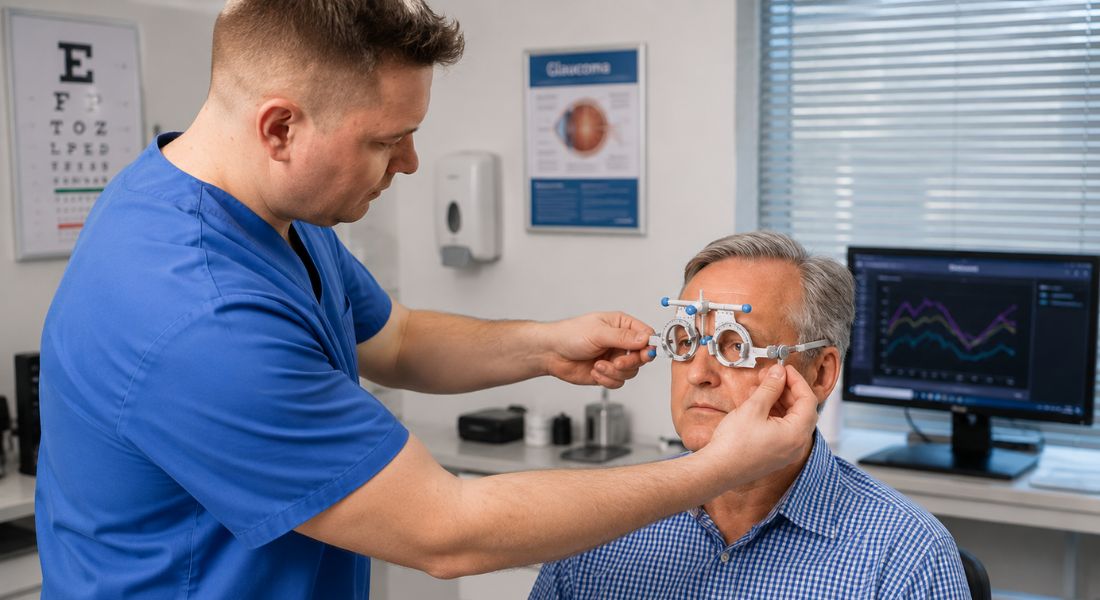
A contact-lens sensor may record small changes in your eye’s dimensions over approximately 24 hours while you continue selected daily activities and sleep. These changes may provide your glaucoma specialist with information about patterns that are not captured during one clinic eye-pressure measurement.
A device such as Triggerfish does not directly measure your intraocular pressure in mmHg. It records a relative electrical signal linked to changes in your eye’s shape, and your specialist must interpret your profile alongside your measured eye pressure, corneal findings, optic-nerve examination, OCT and visual fields.
How Continuous Monitoring May Help
| Feature | What It Means for You | Important Limitation for You |
| Repeated recording | Your sensor can collect measurements across the day and night | Your measurements may not represent pressure directly |
| Daily activities | Your result reflects patterns while you follow parts of your normal routine | Your blinking, eye movements and lens fit may influence the signal |
| Night-time recording | Your sensor may identify pressure-related patterns while you sleep | Your result does not independently show whether your glaucoma is progressing |
| Relative profile | Your specialist may assess changes and fluctuations over time | Your sensor may report electrical units rather than mmHg |
| Clinical interpretation | Your result may add information to your glaucoma assessment | Your OCT, optic-nerve examination and visual fields remain necessary |
Measuring Tear Biomarkers
Researchers are developing lenses intended to measure substances in your tears, including glucose, electrolytes, proteins and inflammatory molecules. Your tear composition may provide useful research information about your ocular surface or other biological processes.
Your tear concentration may not correspond directly with the concentration in your blood or deeper eye tissues. These lenses cannot currently diagnose diabetes or most eye diseases and remain largely experimental.
Delivering Eye Medication
Researchers are developing contact lenses that release medication onto your eye over a controlled period. Your lens could theoretically keep a medicine in contact with your ocular surface longer than a conventional eye drop.
Most drug-delivery lenses remain within laboratory research or early clinical development. You should not use a medicated or experimental contact lens unless it has been prescribed and appropriately monitored by your eye-care team.
Monitoring Blinking and Eye Movements
Your wearable eye tracker may measure your blink frequency, gaze direction, fixation, pupil size or eye movements. These measurements can support research into visual attention, fatigue, neurological conditions and rehabilitation.
Your result can be affected by calibration, eyelid position, spectacle fit, lighting and movement. An unusual eye-tracking pattern cannot diagnose your eye or neurological condition independently.
Could Wearables Support Dry Eye Care?

You may blink less frequently or less completely while concentrating on a screen, which can contribute to ocular-surface discomfort. A wearable could potentially identify changes in your blink pattern and remind you to blink or take a break.
Your reminder may improve your screen habits, but it cannot diagnose or treat every cause of dry eye. You should arrange an assessment if your symptoms persist, become painful or affect your sight.
Virtual-Reality Visual Field Testing
A portable head-mounted or virtual-reality perimeter may allow you to perform a visual-field test outside a conventional clinic. Some systems use eye tracking or automated checks to identify when your fixation or test reliability is poor.
Your home result can be affected by your understanding of the test, headset positioning, distractions and adherence. Your clinician should review your results and confirm important changes using an appropriate clinical assessment.
Home Monitoring for Glaucoma
A two-year prospective study enrolled 25 people with stable glaucoma and asked them to perform home visual-field tests regularly. Eighteen participants completed at least one unsupervised test, and their visual-field indices were strongly correlated with their clinic results.
Your interpretation should also reflect the study’s limitations. Compliance fell from 83% during the first two months to 11% during the final two months, and the small, selected group does not establish that every person can maintain reliable long-term home testing.
Smart Glasses for Sight Loss
AI-powered smart glasses can describe objects, recognise text and identify faces in real time. You may also receive spoken navigation guidance as you move through your surroundings.
- Reading support: Your device may read printed or digital text aloud.
- Object information: Your device may describe selected items or parts of your surroundings.
- Stored-face recognition: Your device may identify people whose images you have deliberately registered.
- Navigation assistance: Your device may provide supplementary obstacle or direction cues.
- Your independence: Your device may make selected tasks easier without replacing your mobility skills or human support.
- Your privacy: Your camera and face-recognition features may capture information about other people, so responsible use and secure data handling are important.
Smart glasses can support your independence by improving how you interact with your surroundings. While they do not restore normal vision, they can make everyday activities more accessible and easier to manage.
What Did a Recent Smart-Glasses Study Find?
A 2025 multicentre Indian study recruited 90 people with severe visual impairment or blindness from five rehabilitation centres. Participants used a spectacle-mounted AI device for one month, and 85 completed the feedback assessment.
Reading received positive feedback from 72.9% of respondents, while walking assistance received positive feedback from 22.4%. The study assessed short-term acceptance and perceived usefulness rather than proving that the device improved your safety, mobility or long-term independence.
Monitoring Retinal Disease at Home
Wearable or portable devices may record aspects of your reading, mobility or visual behaviour during everyday tasks. Your data could eventually help researchers understand how a retinal condition affects you beyond the visual-acuity chart.
These measurements are not established substitutes for your OCT, retinal photography or specialist examination. Your real-world behaviour can also be affected by your general health, surroundings, confidence and familiarity with the device.
Supporting Visual Rehabilitation
Your virtual or augmented-reality device may magnify images, increase contrast or reposition information into an area where you have better remaining vision. Your settings may need to be adapted according to your condition, visual field and comfort.
Your device may support selected tasks but cannot restore damaged retinal or optic-nerve tissue. A low-vision specialist should help you determine whether the technology is useful and safe for your needs.
How Could Artificial Intelligence Help?
AI may analyse the large volume of information collected by your wearable and identify measurements that require review. Your result could potentially help your clinician prioritise information that would be difficult to assess manually.
Your AI system may also produce false alarms or miss genuine changes because of movement, poor fit, limited data or differences between you and the people used to develop the model. Your clinician must remain responsible for interpreting the result and making decisions about your care.
What Are the Main Limitations?
Your wearable may be limited by comfort, battery life, cost, connectivity, calibration and your willingness or ability to use it consistently. Inaccurate measurements, false alerts and large volumes of low-quality data may reduce its clinical usefulness.
Your device may also collect sensitive information about your health, location, behaviour or surroundings. You should understand how your data are stored, shared and protected and should not change your treatment solely because of an unverified consumer-device result.
Myth vs Fact
| Myth | What You Should Know |
| Your wearable can replace your comprehensive eye examination. | Your device may provide additional information, but your professional assessment remains necessary. |
| Your light-monitoring watch can prevent your child’s myopia. | Your watch can record outdoor exposure but cannot prevent myopia independently. |
| Your smart contact lens directly measures your eye pressure. | Your sensor may record pressure-related changes rather than pressure in mmHg. |
| Your normal wearable result proves that you do not have glaucoma. | Your diagnosis requires your optic-nerve, visual-field and other clinical assessments. |
| Your home visual-field test will always be reliable. | Your result can be affected by your technique, environment and long-term adherence. |
| Your smart glasses restore your normal vision. | Your glasses may support selected activities but cannot reverse your sight loss. |
| Your AI navigation system is safe enough to replace your mobility aids. | Your device should supplement rather than replace your cane, guide dog or mobility training. |
| Your tear-sensing lens can diagnose diabetes. | Your tear levels do not necessarily correspond reliably with your blood levels. |
| Your consumer wearable is automatically a medical device. | Your product’s intended purpose and regulatory status determine how it should be classified. |
Key Takeaways
- Your wearable device may support monitoring, rehabilitation or everyday visual tasks.
- Your consumer wearable should not be assumed to provide a medically validated result.
- Your child’s light sensor may record outdoor exposure but cannot prevent myopia independently.
- Your smart contact lens may detect pressure-related patterns without directly measuring your eye pressure in mmHg.
- Your glaucoma diagnosis still requires examination of your optic nerve, visual fields and other clinical findings.
- Your home visual-field test may provide additional information, but your ability to use it regularly can affect its value.
- Your smart glasses may support reading or object recognition without restoring your normal sight.
- Your tear-sensing and drug-delivery lenses remain primarily within research.
- Your AI-generated result may be affected by poor fit, movement, image quality or limited training data.
- Your wearable should complement rather than replace your established eye care.
Frequently Asked Questions
- Can wearable technology improve your eye health?
Your wearable may support your visual function, rehabilitation or monitoring by collecting repeated information about your eyes and daily activities. It cannot replace your professional eye examination or guarantee earlier diagnosis. - Which types of wearable eye technology could you use?
You may encounter smart glasses, sensor-equipped contact lenses, head-mounted displays, eye trackers and light-monitoring watches. Your device’s usefulness depends on whether it is intended for assistance, wellbeing, research or clinical monitoring. - Why could continuous monitoring be useful to you?
Your repeated measurements may reveal changes that are not captured during one clinic appointment. Your clinician must still decide whether your data are accurate, reliable and relevant to your care. - Can your wearable prevent myopia?
No. Your child’s wearable may record outdoor light exposure and encourage healthier routines, but it cannot prevent or treat myopia independently. Your child still needs appropriate eye examinations and prescribed vision correction. - What is your smart contact lens?
Your smart contact lens contains sensors or other miniature components designed to perform a function beyond ordinary vision correction. Depending on the device, it may record pressure-related changes or experimentally analyse tears or deliver medication. - Can your smart contact lens diagnose glaucoma?
No. Your contact-lens result cannot diagnose glaucoma independently. Your clinician must assess your optic nerve, visual fields, eye pressure, cornea, OCT findings and other risk factors. - Could your wearable support dry-eye management?
Your wearable may monitor your blinking or remind you to take screen breaks. These reminders may improve your habits, but they cannot diagnose or treat every cause of your dry-eye symptoms. - Can you perform visual-field testing at home?
You may be able to use a portable headset or another approved system for supplementary home testing. Your results require clinical review and should not replace your scheduled glaucoma examinations. - How could smart glasses help you if you have sight loss?
Your smart glasses may read text, describe objects or provide supplementary information about your surroundings. They cannot restore your normal vision or safely replace your established mobility aids. - What are the limitations of wearable technology in your eye care?
Your device may be affected by comfort, accuracy, calibration, cost, battery life, connectivity and inconsistent use. Your privacy, data security and the risk of misleading results must also be considered.
Final Thoughts: The Future of Wearable Technology in Your Eye Care
Your wearable may support selected visual tasks, record information between appointments or allow supplementary testing outside the clinic. Current examples include assistive smart glasses, experimental contact lenses, light sensors and portable visual-field systems, but their accuracy, clinical purpose and level of validation differ substantially.
Your wearable cannot replace a comprehensive eye examination, clinician-reviewed OCT and visual-field assessment, or specialist interpretation. Many disease-prediction, tear-sensing and drug-delivery applications remain investigational.
If you have any concerns about your vision or would like a detailed assessment, you can contact us at Eye Clinic London to arrange a consultation and discuss the most appropriate care for your eyes.
References
- Ashwini, D.L., Ve, R.S., Nosch, D. and Wilmot, N. (2021) ‘Efficacy of blink software in improving the blink rate and dry eye symptoms in visual display terminal users: a single-blinded randomised controlled trial’, Indian Journal of Ophthalmology, 69(10), pp. 2643–2648. Available at: https://pmc.ncbi.nlm.nih.gov/articles/PMC8597488/
- Bhandari, K.R., Mirhajianmoghadam, H. and Ostrin, L.A. (2021) ‘Wearable sensors for measurement of viewing behaviour, light exposure, and sleep’, Sensors, 21(21), article 7096. Available at: https://pmc.ncbi.nlm.nih.gov/articles/PMC8587946/
- framework for digital health technologies. Corporate document ECD7. Last updated 9 August 2022. Available at: https://www.nice.org.uk/corporate/ecd7
- National Institute for Health and Care Excellence (2017) Glaucoma: diagnosis and management. NICE guideline NG81. Last updated 26 January 2022 and last reviewed 26 March 2025. Available at: https://www.nice.org.uk/guidance/ng81
- Shi, R.B., Li-Han, L.Y., Kherani, I.N., Trope, G.E., Buys, Y.M., Wong, W. and Eizenman, M. (2025) ‘Virtual reality portable perimetry and home monitoring of glaucoma: retention and compliance over a two-year period’, Ophthalmology Science, 5(2), article 100639. Available at: https://pmc.ncbi.nlm.nih.gov/articles/PMC11634999/