


How Does Parkinson’s Disease Affect Vision?

If you have Parkinson’s and have noticed changes in your vision, such as dry eyes, blurred vision or more difficulty reading, these changes may be linked to the condition.
Some visual problems are linked to Parkinson’s, while others may result from medication, ageing or separate eye conditions. If your vision changes persist, an eye assessment can help identify the cause.
Why Can Parkinson’s Disease Affect Your Vision?
Parkinson’s affects brain systems involved in movement, eye control and visual processing, so changes in dopamine and related networks can influence how you see. You may experience problems with contrast, colour, depth perception or eye movements even when a standard eye test shows fairly good vision.
This is because seeing clearly depends on both your eyes and your brain working together. The type and severity of visual changes can vary from person to person.
What Does the Research Show?
Visual complaints are common and varied in Parkinson’s disease. A systematic review of 139 studies found that people with Parkinson’s reported more visual problems than healthy comparison groups, including blurred or double vision, altered contrast sensitivity and difficulties with activities such as reading and driving. Visual complaints were also associated with poorer quality of life.
Dry eye is particularly well studied. A systematic review and meta-analysis involving 1,519 people with Parkinson’s estimated that 61.1% reported dry-eye symptoms. Compared with control groups, people with Parkinson’s also had lower blink rates, shorter tear-film break-up times and lower tear secretion measurements. These are population-level findings and do not mean that everyone with Parkinson’s will develop dry eye.
How Can Parkinson’s Affect Your Eye Movements?
Parkinson’s can affect several types of eye movement, including the rapid movements used to shift your gaze, known as saccades, and the smooth movements used to follow a moving object. Some movements may become slower, smaller or harder to initiate.
These changes can contribute to blurred vision or reading difficulties. However, unusual or severe eye-movement problems can have other neurological causes, so it is worth discussing persistent changes with your specialist.
Why Can Parkinson’s Make Reading More Difficult?
Parkinson’s can affect the eye movements and coordination you use when reading. This may make it harder to follow text comfortably.
- Eye movements: You may find it harder to move smoothly from one word or line to another.
- Convergence: Difficulty turning and keeping your eyes inward together for near tasks can cause eye strain, blurred vision or double vision when reading.
- Dry eyes: Reduced blinking can make reading uncomfortable or temporarily blurry.
- Low contrast: Text may be harder to see clearly, particularly in poor lighting.
An eye assessment can help identify whether eye-movement problems, convergence difficulty, dry eye, reduced contrast or your glasses prescription are contributing to your reading difficulties. Treatment or practical changes may include updated spectacles, prism correction in selected cases, lubricating drops, better lighting or changes to how reading material is positioned.
Can Parkinson’s Disease Cause Double Vision?
Yes, Parkinson’s can sometimes cause double vision, particularly when your eyes have difficulty working together. Convergence problems may make it harder to focus on close objects such as your phone, tablet or a book.
Glasses, prism correction or other treatment may help depending on the cause. Do not assume new double vision is simply caused by Parkinson’s. If double vision starts suddenly, seek urgent medical advice through your GP or NHS 111, as there are several possible causes that need assessment.
Why Do You Blink Less With Parkinson’s?
Parkinson’s can reduce how often you blink, which may leave your eyes feeling dry, sore or gritty. Blinking helps spread tears across your eye surface, so reduced blinking can affect your tear film.
You may notice symptoms more when reading, watching television or using a computer because you naturally blink less while concentrating. Your eyes may then become uncomfortable or temporarily blurry, particularly later in the day.
How Can Parkinson’s Cause Dry Eye?
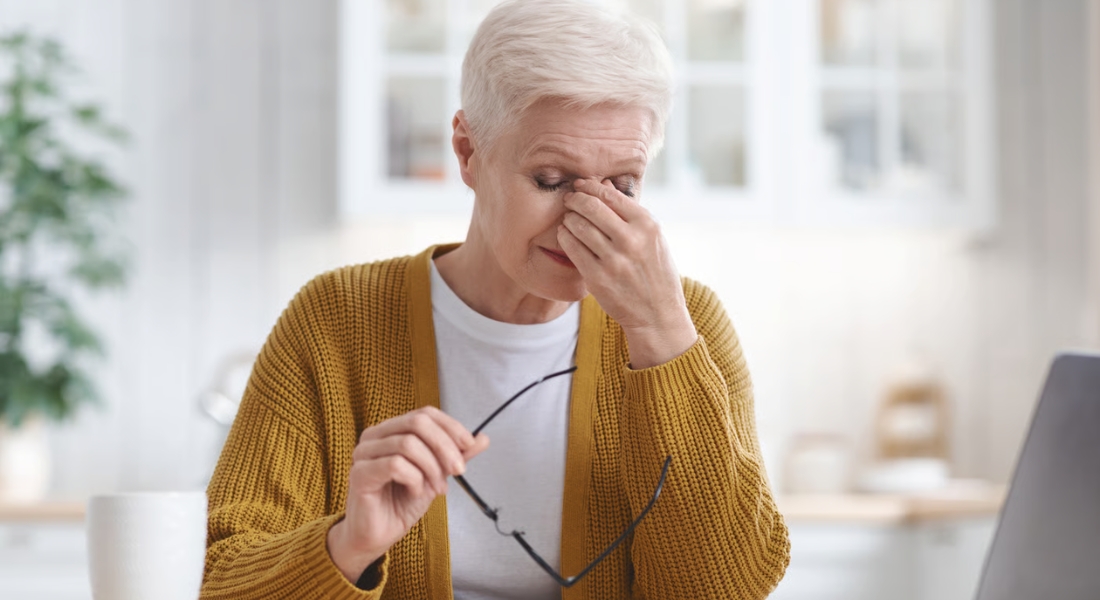
Parkinson’s can contribute to dry eye in several ways. Reduced blinking means tears are spread across the eye surface less frequently, while changes in tear secretion and the ocular surface may also contribute. You may notice burning, grittiness, redness, watering, tired eyes or temporary blurred vision, particularly when reading or using screens.
Dry eyes can sometimes cause watery eyes too, as irritation triggers extra tearing. Symptoms may become more noticeable during reading, screen use or other activities that require prolonged concentration. Artificial tears may help, while an eye-care professional can assess your tear film and eye surface and advise whether lubricating drops or other treatment may be suitable. Persistent dryness, pain, redness or changes in your vision should be assessed by an eye specialist.
What Is Contrast Sensitivity and Why Can Parkinson’s Affect It?
Contrast sensitivity is your ability to see objects when they are only slightly different from their background. Parkinson’s can affect the retinal and brain pathways involved in contrast processing, reducing your ability to distinguish objects from backgrounds with similar brightness.
Reduced contrast sensitivity may be particularly noticeable in dim lighting or when objects are similar in brightness to their background. Steps, kerbs, doorways or objects in shadow may therefore be harder to distinguish. Improving lighting, reducing glare and using stronger contrasts around your home can make everyday tasks easier, even though these changes do not treat the underlying Parkinson’s.
Why Can Vision Be More Difficult in Low Light?
Parkinson’s can make it harder to see clearly when lighting is dim or when objects do not stand out strongly from their background. Reduced contrast sensitivity can make steps, kerbs, doorways or objects in shadow more difficult to distinguish, even when your standard visual acuity is relatively good.
Good lighting can therefore make everyday activities easier. Brighter task lighting for reading, reducing glare and using clear colour contrast around steps or furniture may help you see your surroundings more comfortably and reduce visual uncertainty.
Can Parkinson’s Change the Way You See Colours?
Parkinson’s can sometimes affect how you distinguish colours, particularly certain similar shades. You may notice this more when colours have low contrast or lighting is poor.
However, changes in colour vision can also have other eye-related causes. If colours suddenly look different, particularly in one eye or alongside reduced vision, you should arrange an eye assessment.
Can Parkinson’s Affect Depth Perception and Spatial Awareness?
Parkinson’s can sometimes affect how you judge distances and understand where objects are around you. You may find steps, narrow spaces, furniture or changes in floor levels harder to navigate, particularly when lighting is poor.
These visual-spatial difficulties can add to existing balance or movement problems and may be more noticeable in busy or unfamiliar environments. Judging several objects, narrow spaces or changes in floor level at once can become more difficult. Good lighting, clear contrasts, uncluttered walkways and taking extra time when moving around may help you navigate more safely.
Can Parkinson’s Affect How You See Movement?
Parkinson’s can affect how your brain processes movement as well as how your eyes move. You may find it harder to judge the speed or direction of moving objects, such as cars, particularly in busy environments.
This can affect activities such as crossing roads or driving. If you notice changes in how you judge movement, speak to your Parkinson’s specialist and eye-care professional.
Can Parkinson’s Affect Your Eyelids?
Parkinson’s can sometimes affect eyelid control. Some people develop difficulty initiating eyelid opening, sometimes described as apraxia of eyelid opening, while involuntary eyelid closure can occur with conditions such as blepharospasm.
Repeated or involuntary eyelid closure can have other causes, such as blepharospasm or different neurological conditions. If this happens regularly, speak to your neurologist or eye specialist so the cause can be assessed.
Can Parkinson’s Cause Visual Hallucinations?
Yes, some people with Parkinson’s experience visual hallucinations, such as seeing people, animals or objects that are not actually there. Visual hallucinations can occur at different stages of Parkinson’s but tend to become more common as the condition progresses. They may be influenced by Parkinson’s itself, cognitive changes, medication and other medical problems.
If you experience new or worsening hallucinations, tell your Parkinson’s team. Your healthcare professional may need to review your medicines and look for other possible triggers, including illness or changes in cognition. Do not alter Parkinson’s medication yourself.
Can Parkinson’s Medication Affect Your Eyesight?

Some Parkinson’s medicines can contribute to visual symptoms. Dopaminergic medicines can increase the risk of hallucinations in some people, while individual medicines may have other ocular or visual side effects. If symptoms begin or noticeably worsen after a medication change, tell your Parkinson’s specialist and eye-care professional.
Do not stop or change your medication yourself. Your doctor can review your treatment while also checking for other possible causes of your vision changes.
Why Regular Eye Checks Still Matter
New or worsening visual hallucinations should be discussed with your Parkinson’s healthcare team. Possible triggers can include medication effects, illness and cognitive changes, and Parkinson’s medicines should not be reduced or changed without appropriate specialist advice.
Regular eye examinations are also useful because common age-related eye conditions can occur alongside Parkinson’s and may contribute to visual symptoms. Persistent or changing visual problems should be assessed rather than automatically attributed to Parkinson’s.
How Are Vision Problems Assessed When You Have Parkinson’s?
Your eye assessment may look at both your eyesight and how Parkinson’s affects your eye movements and visual processing. Your optometrist or ophthalmologist may check your vision, eye health, glasses prescription and symptoms such as dry eye or double vision.
If needed, an orthoptist or your Parkinson’s specialist may assess eye coordination and movement. Depending on your symptoms, the assessment may also consider eye alignment, convergence, contrast sensitivity, tear-film problems or the ocular surface. Tell your eye-care professional that you have Parkinson’s so they can distinguish possible Parkinson’s-related visual changes from other common eye conditions that may require different treatment.
Common Visual Problems in Parkinson’s
| Visual problem | What you may notice | What may help |
| Reduced blinking / dry eye | Grittiness, burning, watering or intermittent blur | Ocular-surface assessment and suitable lubricating treatment |
| Convergence difficulty | Near blur, eye strain or double vision when reading | Orthoptic assessment, updated spectacles or prisms in selected cases |
| Eye-movement changes | Losing your place when reading or difficulty shifting gaze | Eye-movement or orthoptic assessment |
| Reduced contrast sensitivity | Difficulty seeing steps, kerbs or low-contrast objects | Better lighting and stronger environmental contrast |
| Visuospatial difficulty | Problems judging distance or navigating cluttered spaces | Occupational-therapy input and environmental adaptations |
| Hallucinations | Seeing people, animals or objects that are not present | Parkinson’s-team review of medicines, cognition and other possible triggers |
What Can You Do to Make Vision Problems Easier to Manage?
What helps you will depend on the cause of your visual symptoms. Lubricating eye drops may help with dryness, while good lighting and stronger contrasts can make objects, steps and doorways easier to see.
Keeping your glasses prescription up to date is also important. If reading or double vision is a problem, your specialist can check your eye alignment and consider options such as prescription changes or prism correction. Improving lighting, reducing glare and creating stronger contrast around steps, doorways and furniture may also make everyday activities easier and safer.
Myth vs Fact
| Myth | Fact |
| Parkinson’s only affects movement. | Parkinson’s can also affect eye movements, blinking and several aspects of visual processing. |
| A normal eye-chart result means Parkinson’s is not affecting your vision. | Contrast sensitivity, eye coordination and visuospatial processing can be affected even when standard visual acuity is relatively good. |
| Every episode of double vision is caused by Parkinson’s. | No. Sudden double vision has many possible causes and needs urgent medical assessment. |
| Dry eye in Parkinson’s is only caused by reduced blinking. | Reduced blinking is important, but tear production, ocular-surface changes and autonomic dysfunction can also contribute. |
| Hallucinations mean there is something wrong with the eyes. | Hallucinations in Parkinson’s may relate to medication, Parkinson’s itself, cognition or another medical problem and should be discussed with the Parkinson’s team. |
| You should change Parkinson’s medication yourself if vision becomes blurred. | No. Medication changes should be discussed with the prescribing team because suddenly altering treatment can worsen Parkinson’s symptoms. |
When Should You Have Your Vision Assessed?
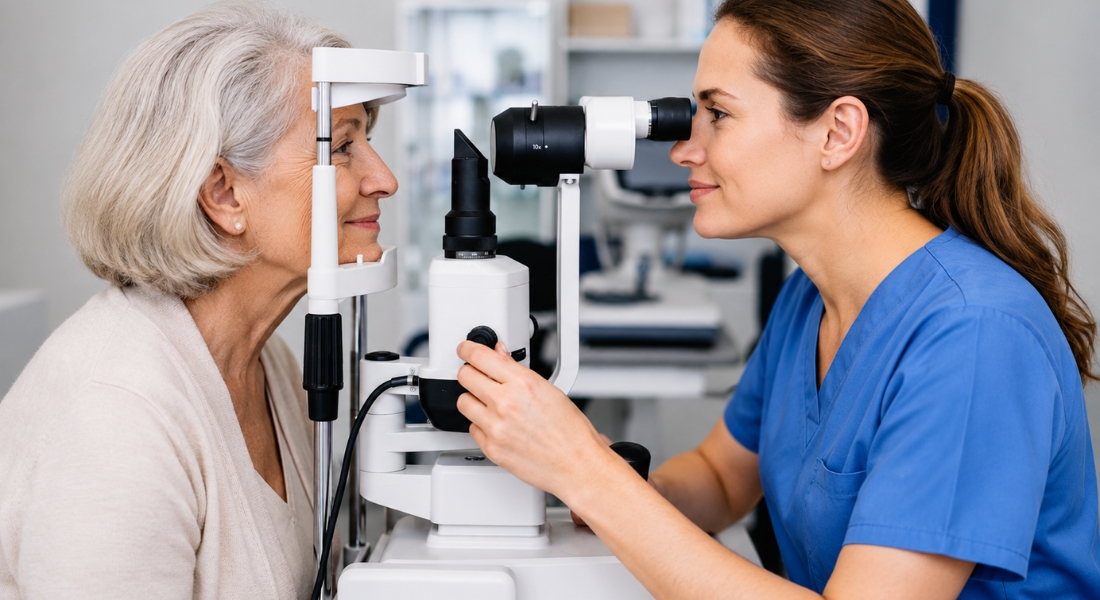
Regular eye checks are important because you can still develop common eye conditions alongside Parkinson’s. Regular optometrist eye examinations are useful even if you are not experiencing obvious eye problems, particularly because other eye conditions can develop alongside Parkinson’s.
Seek urgent GP or NHS 111 advice if you develop sudden-onset double vision or another significant new change in your vision. If you suddenly cannot see from one or both eyes or suddenly develop severe eye pain, go to A&E or call 999. New or worsening visual hallucinations should also be discussed with your Parkinson’s team.
Key Takeaways
- Parkinson’s can affect eye movements, blinking and the way visual information is processed, even when standard visual acuity remains relatively good.
- Reduced blinking and other ocular-surface changes can contribute to dry eye, while convergence and eye-movement problems can make reading or near work more difficult.
- Parkinson’s can also affect contrast sensitivity, colour discrimination, depth perception and the ability to judge movement.
- Visual hallucinations may be related to Parkinson’s, medication, cognitive changes or another health problem and should be discussed with the Parkinson’s team.
- Regular optometrist eye examinations can help identify common eye conditions that may occur alongside Parkinson’s and distinguish them from Parkinson’s-related visual symptoms.
- Sudden-onset double vision requires urgent medical advice. Sudden inability to see from one or both eyes or sudden severe eye pain requires A&E or 999 assessment.
Frequently Asked Questions
- Can Parkinson’s disease affect your vision?
Yes, Parkinson’s disease can affect your vision in several ways, including blurred vision, dry eyes, reading difficulties and problems with eye movements. You may also experience reduced contrast sensitivity or difficulty judging depth. - How does Parkinson’s disease affect your eye movements?
Parkinson’s can make some of your eye movements slower, less accurate or harder to start. This may make reading, following moving objects or shifting your gaze more difficult. - Can Parkinson’s disease cause double vision?
Parkinson’s can sometimes contribute to double vision, particularly when the eyes do not work together effectively for near tasks. However, if double vision starts suddenly, seek urgent GP or NHS 111 advice rather than assuming it is caused by Parkinson’s. - Why can Parkinson’s disease cause dry eyes?
Reduced blinking is an important cause of dry-eye symptoms in Parkinson’s because tears are spread across the eye surface less frequently. Changes in tear production and other ocular-surface factors may also contribute. - Can Parkinson’s disease make reading difficult?
Yes, changes in your eye movements can make it harder to follow lines or move smoothly between words when reading. Dry eyes, reduced contrast or an outdated glasses prescription can also make reading more difficult. - Can Parkinson’s disease affect contrast sensitivity?
Yes, Parkinson’s can reduce your ability to see objects when they have little contrast against their background. You may find steps, kerbs or pale objects harder to see, particularly in poor lighting. - Can Parkinson’s disease affect your colour vision?
Yes, Parkinson’s can sometimes affect how you distinguish certain colours, particularly similar shades. However, sudden changes in colour vision can have other causes and should be assessed by an eye-care professional. - Can Parkinson’s disease cause visual hallucinations?
Yes, some people with Parkinson’s experience visual hallucinations, such as seeing people, animals or objects that are not actually there. New or worsening hallucinations should be discussed with your Parkinson’s specialist so the cause can be reviewed. - Can Parkinson’s medication affect your eyesight?
Yes, some Parkinson’s medicines can contribute to blurred vision or other visual symptoms. If you notice changes after starting or changing medication, tell your specialist rather than stopping the medicine yourself. - When should you have your vision assessed?
Arrange an eye assessment for persistent blurred vision, dry eye, reading difficulties or other changing visual symptoms. Sudden-onset double vision requires urgent medical advice. If you suddenly cannot see from one or both eyes or suddenly develop severe eye pain, go to A&E or call 999.
Final Thoughts: Looking After Your Vision With Parkinson’s Disease
Parkinson’s disease can affect your vision in ways that are not always obvious, from dry and gritty eyes to reading difficulties, reduced contrast sensitivity and problems with eye movements. While some visual changes may be linked to Parkinson’s or its treatment, other symptoms can have separate causes, so you should not assume every change in your eyesight is part of the condition.
If you have Parkinson’s and are concerned about persistent or changing visual symptoms, our team at Eye Clinic London would be happy to talk through what you have noticed and how an eye assessment may help. If it feels helpful, we can also arrange an appointment.
References:
- van der Lijn, I. et al. (2022) ‘Self-Reported Visual Complaints in People with Parkinson’s Disease: A Systematic Review’, Journal of Parkinson’s Disease, 12(3), pp. 785–806. Available at: https://pubmed.ncbi.nlm.nih.gov/35001897/
- Nagino, K. et al. (2022) ‘Prevalence and characteristics of dry eye disease in Parkinson’s disease: a systematic review and meta-analysis’, Scientific Reports, 12(1), 18348. Available at: https://pubmed.ncbi.nlm.nih.gov/36319814/
- Armstrong, R.A. (2015) ‘Oculo-Visual Dysfunction in Parkinson’s Disease’, Journal of Parkinson’s Disease, 5(4), pp. 715–726. Available at: https://pmc.ncbi.nlm.nih.gov/articles/PMC4927837/
- Nieto-Escamez, F., Obrero-Gaitán, E. and Cortés-Pérez, I. (2023) ‘Visual Dysfunction in Parkinson’s Disease’, Brain Sciences, 13(8), 1173. Available at: https://www.mdpi.com/2076-3425/13/8/1173
- Ekker, M.S. et al. (2017) ‘Ocular and visual disorders in Parkinson’s disease: Common but frequently overlooked’, Parkinsonism & Related Disorders, 40, pp. 1–10. Available at: https://www.sciencedirect.com/science/article/abs/pii/S1353802017300640