


Can Alzheimer’s Disease Cause Changes in the Eyes?
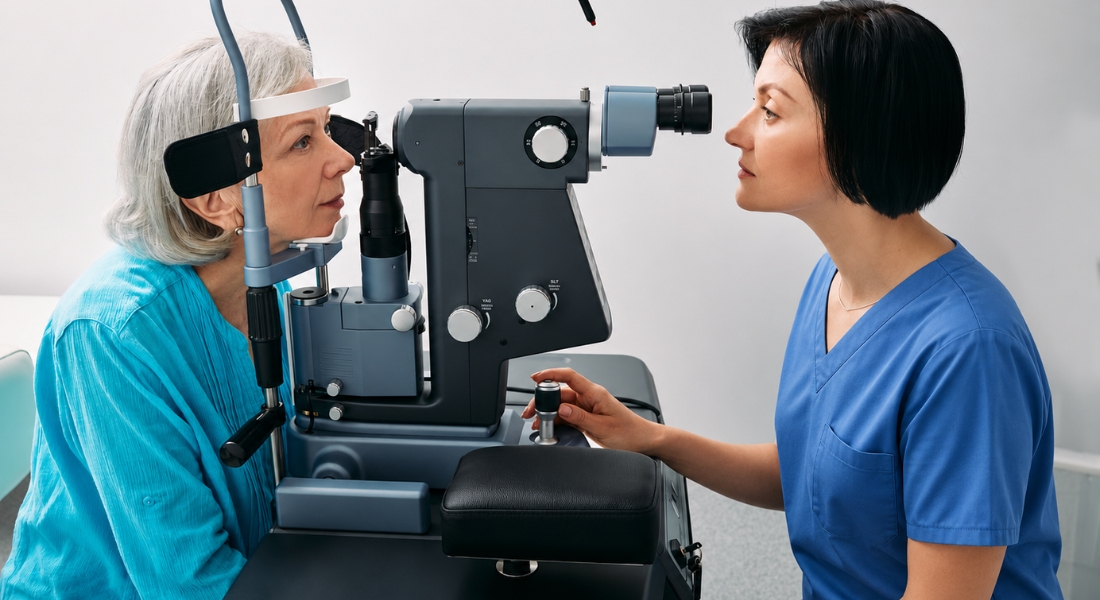
If you have Alzheimer’s disease, changes in your vision are not always caused by a problem with your eyes themselves. Alzheimer’s can affect how your brain processes visual information, so your eyes may still form a relatively clear image while your brain has difficulty interpreting or making sense of what you see.
You may find it harder to judge distances, recognise objects, distinguish similar colours or make sense of busy scenes. Researchers are also studying structural and vascular changes in the retina and visual pathway that may be associated with Alzheimer’s disease, but retinal imaging is not currently established as a standalone diagnostic test.
Why Can Alzheimer’s Disease Affect Your Vision?
Alzheimer’s can affect the areas of your brain that process visual information, even when a routine eye examination does not identify an eye problem that fully explains your symptoms. You may find it harder to recognise objects, judge distances, distinguish colours or understand busy scenes.
You may therefore feel that you cannot see something clearly even when your eyesight test is normal. The difficulty can be caused by how your brain interprets what you see rather than by poor eyesight itself.
Evidence Note
Research shows that Alzheimer’s disease can affect several aspects of visual function as well as higher-order visual processing. A 2024 systematic review including 51 studies found that people with dementia performed more poorly than cognitively healthy controls on measures of contrast sensitivity, colour vision and motion perception. Similar results were found when analyses were restricted to people with clinically diagnosed Alzheimer’s disease.
These visual difficulties are not always explained by reduced visual acuity. Changes in brain networks involved in recognising objects, interpreting space, directing visual attention and processing movement can make everyday vision difficult even when a standard eye-chart result remains relatively good. These are group-level findings and cannot predict exactly which visual symptoms an individual person will experience.
What Is the Difference Between Eyesight and Visual Processing?
Your eyesight is about how clearly your eyes detect an image, while visual processing is how your brain understands what you see. Alzheimer’s can affect this processing even when your visual acuity is relatively well preserved and an eye examination does not fully explain the difficulty.
You may recognise an object but struggle to judge its distance or understand where it is. This is why updating your glasses may not fully solve visual difficulties caused by changes in how your brain processes information.
Eyesight Problems vs Visual Processing Problems
| Feature | Eyesight problem | Visual processing problem |
| What is affected | The eyes or structures involved in forming a clear image | The brain’s ability to interpret visual information |
| Typical difficulty | Blurred, hazy or reduced vision | Difficulty understanding or interpreting what is being seen |
| Reading | Text may appear unclear because visual sharpness is reduced | You may lose your place, skip lines or struggle to process written information |
| Recognising objects | Objects may be difficult to see clearly | You may see an object but struggle to identify or interpret it |
| Judging distance | Can be affected by several eye conditions | Difficulty judging depth, distance or object position |
| Busy environments | Visual clarity itself may be reduced | Crowded or cluttered scenes may be difficult to interpret |
| Can glasses help? | Often, when refractive error is contributing | Stronger glasses may not correct a brain-processing difficulty |
| Assessment | Eye examination can identify many ocular causes | Persistent difficulties may need neurological or cognitive assessment as well as an eye examination |
Can Alzheimer’s Make It Harder to Judge Distance and Space?
Alzheimer’s can affect how your brain judges distance, depth and where objects are positioned. You may find stairs, crowded spaces or reaching for objects more difficult than before.
Poor lighting or low contrast can make these problems more noticeable. Better lighting and clearly defined steps or floor edges may make moving around your home easier and safer.
Can Alzheimer’s Affect Contrast Sensitivity?
Alzheimer’s may affect your ability to distinguish objects from backgrounds with similar shades, even when you can read a standard eye chart well. You might find steps, furniture or objects harder to see in dim lighting.
Using stronger contrast can make everyday tasks easier. For example, brighter lighting and clearly contrasting objects or floor edges may help you recognise your surroundings more easily.
Can Alzheimer’s Affect Colour and Motion Perception?
Alzheimer’s may affect how your brain processes colours and movement, even when your basic eyesight remains fairly clear. You might find similar shades harder to distinguish or have more difficulty following moving objects in busy surroundings.
These changes are not specific to Alzheimer’s, as eye conditions can cause similar symptoms. If colour vision or general vision changes suddenly, particularly in one eye, seek prompt medical or eye-care assessment rather than assuming the change is related to Alzheimer’s.
Why Can Recognising Objects and Faces Become Difficult?

Alzheimer’s can affect brain networks involved in recognising familiar objects and faces. Difficulty recognising objects may be described as visual agnosia, while difficulty recognising familiar faces is sometimes called prosopagnosia.
This is different from blurred eyesight, so stronger glasses may not solve the problem. Keeping rooms less cluttered and giving yourself more time to identify objects can sometimes make everyday tasks easier.
Can Alzheimer’s Make Reading More Difficult?
Alzheimer’s can make reading more difficult by affecting how your brain processes and follows written information. You may find that reading takes more effort than before.
- Losing your place: You may find it harder to follow lines of text.
- Crowded text: Small or closely spaced words may be more difficult to process.
- Visual attention: You may struggle to focus on the relevant part of a page.
- Reading comfort: Larger text and better lighting may make reading easier.
An eye test can also help identify other problems, such as cataracts or an outdated glasses prescription. These may add to your reading difficulties.
Can Alzheimer’s Change Your Eye Movements?
Alzheimer’s can affect the brain networks that control your eye movements. You may find it harder to scan a busy scene, shift your gaze quickly or find a particular object.
Researchers are studying eye movements as a possible way to understand neurological changes, but eye-tracking is not currently a standalone test for diagnosing Alzheimer’s.
Can Alzheimer’s Cause Visual Misperceptions or Hallucinations?
Alzheimer’s can sometimes affect how your brain interprets what you see. You may mistake a shadow or pattern for something else, while visual hallucinations involve seeing something that is not actually there.
Hallucinations are more common in some other types of dementia, but they can occur with Alzheimer’s. If they appear suddenly, speak to your healthcare team because infection, medication, delirium or sight loss may also be responsible.
What Is Posterior Cortical Atrophy?
Posterior cortical atrophy (PCA) is a neurodegenerative syndrome in which higher-order visual and spatial abilities are affected early because posterior brain regions involved in visual processing are particularly affected.
You may have difficulty reading, judging distances, recognising objects or navigating, even when routine eye tests are fairly normal. Persistent unexplained visual problems may therefore need further neurological assessment.
Why Can Posterior Cortical Atrophy Be Difficult to Recognise?
Posterior cortical atrophy can initially be mistaken for an eye problem because visual and spatial difficulties may appear before more typical memory symptoms become prominent. Research indicates that Alzheimer’s disease is the most common underlying pathology, accounting for more than three-quarters of cases in several pathological and biomarker studies.
Symptoms can include difficulty locating objects, judging where things are in space, reading or navigating familiar surroundings. Because routine eye examinations may not fully explain these problems, persistent or progressive visual difficulties may require neurological or cognitive assessment as well as an eye examination. PCA often has a younger age of onset than typical Alzheimer’s disease, although it can occur across a wide age range.
Are Retinal Changes Associated With Alzheimer’s Disease?
Researchers have reported structural retinal differences in people with Alzheimer’s disease. OCT studies have described thinning of measures such as the retinal nerve fibre layer and ganglion-cell-related layers, while OCT angiography studies have reported differences in retinal vessel density and other microvascular measurements.
However, study results vary according to participant selection, eye conditions, imaging equipment and analysis methods. These findings are therefore being investigated as potential biomarkers rather than used as routine diagnostic criteria for Alzheimer’s disease.
What Changes Are Researchers Investigating in the Retinal Nerve Fibre Layer?
Researchers are studying whether Alzheimer’s can affect the retinal nerve fibre layer, which contains the axons of retinal ganglion cells that converge to form the optic nerve. Some studies have found thinning in people with Alzheimer’s, but the findings are not specific enough to diagnose the disease.
Other conditions, including glaucoma and normal ageing, can also affect this measurement. So, if an OCT scan shows a thin nerve fibre layer, it does not mean that you have Alzheimer’s disease.
Can Alzheimer’s Affect the Small Blood Vessels in the Retina?

Meta-analyses have reported differences in several OCT-A measurements, including lower retinal vessel density in groups with Alzheimer’s disease. However, results vary between studies and can be influenced by scan size, imaging equipment and other vascular or eye conditions.
However, ageing, vascular conditions and co-existing eye disease can also affect retinal measurements, making Alzheimer-specific changes difficult to identify reliably. So, these changes may be useful for research, but they cannot currently confirm that you have Alzheimer’s.
Can an Eye Scan Diagnose Alzheimer’s Disease?
At the moment, no routine eye scan can diagnose Alzheimer’s on its own. Researchers have found possible changes in the retina and its blood vessels, but results are still inconsistent and not specific enough for routine diagnosis.
Diagnosing Alzheimer’s disease requires appropriate clinical and cognitive assessment. Depending on the individual situation, specialist assessment may also involve structural brain imaging, neuropsychological testing or established Alzheimer’s biomarkers. Retinal OCT and OCT-A are not currently standalone diagnostic tests for Alzheimer’s disease.
Clinical Guidance Note
People living with dementia should continue to have regular eye examinations because cataract, glaucoma, refractive error, retinal disease and other treatable eye problems can occur alongside neurological visual-processing difficulties.
An eye examination is intended to identify eye disease and correctable sight problems; it is not a test for diagnosing Alzheimer’s disease. If visual difficulties persist and an eye examination does not identify a cause that fully explains them, further neurological or cognitive assessment may be appropriate.
What Can Make Everyday Visual Tasks Easier?
Visual-processing difficulties can become more noticeable in cluttered, poorly lit or unfamiliar environments. Practical changes may therefore help reduce the amount of visual information that needs to be processed at once.
Keeping important objects in consistent locations, reducing unnecessary clutter and improving lighting may make everyday tasks easier. Strong contrast between objects and their backgrounds can also help when contrast sensitivity or spatial judgement is reduced. Allowing extra time to look around and understand a scene may be useful, particularly when moving through unfamiliar environments or completing visually complex tasks.
How Can Visual Problems Be Assessed and Managed?
If your vision changes, an optometrist or ophthalmologist can check whether an eye condition, such as cataracts or glaucoma, is contributing. This is important because untreated sight problems can make it harder for you to navigate, communicate and stay independent.
If an eye examination does not identify a cause that fully explains difficulties such as recognising objects or judging distances, neurological assessment may be helpful. Good lighting, less clutter and stronger contrast between objects and their surroundings can also make everyday activities easier.
Myth vs Fact
| Myth | Fact |
| If an eye chart is normal, Alzheimer’s cannot be affecting vision. | Alzheimer’s can affect higher-order visual processing, contrast, spatial awareness and recognition even when basic acuity remains relatively good. |
| Every visual problem in someone with Alzheimer’s is caused by dementia. | Cataract, glaucoma, retinal disease and an incorrect glasses prescription can occur alongside dementia and should still be assessed. |
| An OCT scan can diagnose Alzheimer’s disease. | No. Retinal and optic-nerve changes are being researched, but current OCT/OCT-A findings are not sufficiently consistent or specific for standalone diagnosis. |
| Hallucinations always mean Alzheimer’s is getting worse. | No. Hallucinations can also be related to delirium, infection, medicines, sight loss or another dementia subtype such as dementia with Lewy bodies. |
| Posterior cortical atrophy is an eye disease. | No. PCA is a neurodegenerative syndrome affecting brain regions involved in visual processing; Alzheimer pathology is its most common underlying cause. |
When Should You Have Your Eyes or Vision Assessed?

If you notice changes in your vision, arrange an eye examination rather than assuming they are caused by Alzheimer’s. Problems such as cataracts, changes in your prescription or retinal disease can occur alongside dementia and may worsen visual difficulties.
Arrange prompt assessment for persistent or changing visual difficulties rather than assuming they are caused by Alzheimer’s. Sudden-onset double vision requires urgent medical advice. If you suddenly cannot see from one or both eyes or develop sudden severe eye pain, seek emergency medical care. A sudden new visual or visual-processing problem accompanied by facial weakness, weakness or numbness on one side, speech difficulty or acute confusion may be a sign of stroke or TIA. Call 999 immediately.
Key Takeaways
- Alzheimer’s disease can affect how the brain processes visual information, even when visual acuity is relatively well preserved and an eye examination does not fully explain the difficulty.
- Difficulties can involve depth and spatial judgement, contrast, colour, movement, reading and recognising objects or faces.
- Alzheimer’s disease is the most common underlying pathology associated with posterior cortical atrophy, where higher-order visual difficulties can be particularly prominent.
- Researchers have identified possible retinal nerve-fibre, ganglion-cell and microvascular changes in Alzheimer’s disease, but results remain inconsistent.
- OCT and OCT-A cannot currently diagnose Alzheimer’s disease on their own.
- Regular eye examinations are important after a dementia diagnosis because treatable eye conditions can occur alongside neurological visual-processing difficulties.
- Sudden inability to see from one or both eyes or sudden severe eye pain requires emergency medical assessment, while sudden-onset double vision needs urgent medical advice.
Frequently Asked Questions
- Can Alzheimer’s disease cause changes in your eyes?
Alzheimer’s can affect how your brain processes visual information, even when your basic eyesight is relatively well preserved. You may have difficulty judging distances, recognising objects, distinguishing colours or understanding busy scenes. - Can Alzheimer’s disease affect your vision?
Yes, Alzheimer’s can affect visual processing and make everyday vision more difficult. You may struggle with reading, depth perception, contrast or recognising familiar objects despite having relatively clear eyesight. - Can Alzheimer’s disease make it harder to judge distance?
Yes, Alzheimer’s can affect how your brain judges distance, depth and the position of objects around you. You may find stairs, crowded spaces or reaching for objects more difficult, particularly in poor lighting. - Can Alzheimer’s disease affect colour and contrast perception?
Yes, Alzheimer’s may make it harder for you to distinguish similar colours or objects against backgrounds with little contrast. Better lighting and stronger contrasts can make everyday tasks easier. - Can Alzheimer’s disease make reading difficult?
Yes, Alzheimer’s can affect the eye movements and brain processes involved in reading. Larger text, better lighting and simpler page layouts may make reading more comfortable and manageable. - Can Alzheimer’s disease cause visual hallucinations?
Alzheimer’s can sometimes cause visual misperceptions or hallucinations, although hallucinations are more common in some other types of dementia. Sudden hallucinations should be discussed with your healthcare team because medication, infection, delirium or sight loss may also be responsible. - Can Alzheimer’s disease cause changes in the retina?
Research has found group-level differences in retinal nerve-fibre thickness, ganglion-cell-related measurements and retinal microvasculature in some people with Alzheimer’s disease. However, results vary between studies and are not specific enough for retinal imaging to diagnose Alzheimer’s. - Can an eye scan diagnose Alzheimer’s disease?
No, routine eye scans cannot currently diagnose Alzheimer’s disease on their own. Your diagnosis depends on appropriate medical and cognitive assessments, while retinal scans remain mainly a research tool. - What is posterior cortical atrophy?
Posterior cortical atrophy (PCA) is a rare neurological condition that affects areas of the brain involved in visual processing. Alzheimer’s disease is the most common underlying cause of PCA, although other neurodegenerative diseases can also cause the syndrome. - When should you have your vision assessed?
You should arrange an eye examination if you notice changes in your vision rather than assuming they are caused by Alzheimer’s. Call 999 or attend A&E if you suddenly cannot see from one or both eyes or develop sudden severe eye pain. Sudden-onset double vision needs urgent medical advice.
Final Thoughts: Looking After Your Vision With Alzheimer’s Disease
Alzheimer’s disease can affect how your brain processes what you see, even when your basic eyesight is relatively well preserved and an eye examination does not fully explain your visual difficulties. If you notice difficulty recognising objects, judging distances, reading, distinguishing colours or navigating familiar surroundings, you should not assume these changes are simply part of ageing or dementia. An eye examination can help identify treatable eye conditions that may be contributing to your visual difficulties.
If you or someone you care for has persistent or changing visual symptoms, you can arrange an assessment with our team at Eye Clinic London. An eye examination can help identify whether a treatable eye condition may be contributing to the visual difficulties and whether further medical assessment may be appropriate.
References:
- Xu, Y. et al. (2024) ‘Contrast Sensitivity, Visual Field, Color Vision, Motion Perception, and Cognitive Impairment: A Systematic Review’, Journal of the American Medical Directors Association, 25(8), 105098. Available at: https://pubmed.ncbi.nlm.nih.gov/38908397/
- Sheriff, S. et al. (2023) ‘Retinal thickness and vascular parameters using optical coherence tomography in Alzheimer’s disease: a meta-analysis’, Neural Regeneration Research, 18(11), pp. 2504–2513. Available at: https://pmc.ncbi.nlm.nih.gov/articles/PMC10360097/
- Yong, K.X.X. et al. (2023) ‘Diagnosis and Management of Posterior Cortical Atrophy’, Current Treatment Options in Neurology, 25(2), pp. 23–43. Available at: https://pmc.ncbi.nlm.nih.gov/articles/PMC9935654/
- Kaštelan, S. et al. (2025) ‘Non-Invasive Retinal Biomarkers for Early Diagnosis of Alzheimer’s Disease’, Biomedicines, 13(2), 283. Available at: https://www.mdpi.com/2227-9059/13/2/283
- Gaire, B.P. et al. (2024) ‘Alzheimer’s disease pathophysiology in the retina’, Progress in Retinal and Eye Research, 101, 101273. Available at: https://www.sciencedirect.com/science/article/pii/S1350946224000387