


How Artificial Intelligence Is Shaping the Future of ICL Surgery

Artificial intelligence is becoming an important topic in refractive surgery, and ICL surgery is one area where it may make a meaningful difference. ICL surgery involves placing an implantable collamer lens inside your eye to correct vision, so planning needs to be highly accurate. Even small differences in measurements can influence the final outcome.
Unlike LASIK, ICL surgery does not reshape your cornea. Instead, your surgeon needs to choose the right lens size, predict how it will sit inside the eye, and make sure there is enough internal space for safe implantation. This makes pre-operative planning especially important.
Recent research has focused strongly on AI-assisted ICL vault prediction, lens sizing, anterior segment imaging, and surgical planning. Studies published in 2025 suggest that AI may help predict post-operative vault more accurately and support safer ICL size selection. These developments are aimed at improving consistency and reducing uncertainty during treatment planning.
For you, this could mean more personalised planning and more informed decision-making in the future. AI is not expected to replace specialist judgement, but it may provide additional support by analysing complex measurements and identifying patterns that are difficult to assess manually. The overall goal is to make ICL surgery safer, more predictable, and better tailored to each individual patient.
Why AI Is Being Discussed in ICL Surgery
ICL surgery depends on many measurements, including anterior chamber depth, white-to-white distance, sulcus-to-sulcus distance, lens rise, corneal measurements, and anterior segment anatomy. These measurements can interact in complex ways, which makes planning more detailed than simply checking your prescription.
AI is being discussed because it can analyse patterns across large datasets and identify relationships that may be difficult to capture using simple formulas. A 2025 review of AI in refractive surgery specifically discusses its role in laser vision correction and phakic intraocular lens implantation.
For you, the aim is not to replace the surgeon. The aim is to help your surgeon plan ICL surgery with more information, better prediction tools, and greater confidence. Clinical judgement still remains essential, but AI may become a useful support in making ICL planning more personalised and precise.
AI and ICL Vault Prediction
Vault prediction is one of the most important uses of AI in ICL surgery. Vault refers to the space between the implanted ICL and your natural lens. This space needs to be carefully predicted because it can affect long-term safety.
If the vault is too low, there may be concern about contact with the natural lens. If the vault is too high, there may be concern about pressure or angle-related problems. This is why surgeons pay close attention to lens sizing and internal eye measurements.
A 2025 study published in Translational Vision Science & Technology found that AI-based vault prediction could help reduce abnormal post-operative vault and improve the safety of ICL implantation. For you, this means AI may help make ICL planning more accurate, but your surgeon’s judgement still remains essential.
Why Vault Matters So Much
Vault matters because the ICL needs to sit safely inside your eye. The lens should not be too close to your natural lens, but it should also not sit too high. Both situations can create safety concerns that need monitoring.
This is why ICL planning is more complex than simply choosing a lens power. Your surgeon must choose a lens size that matches the internal anatomy of your eye. This includes the space available, lens position, anterior chamber depth, and other detailed measurements.
AI may help by predicting how different lens sizes are likely to behave after implantation. For you, this could support more accurate planning and reduce uncertainty before surgery. However, your surgeon still needs to interpret the results and decide what is safest for your eyes.
AI and Personalised ICL Planning
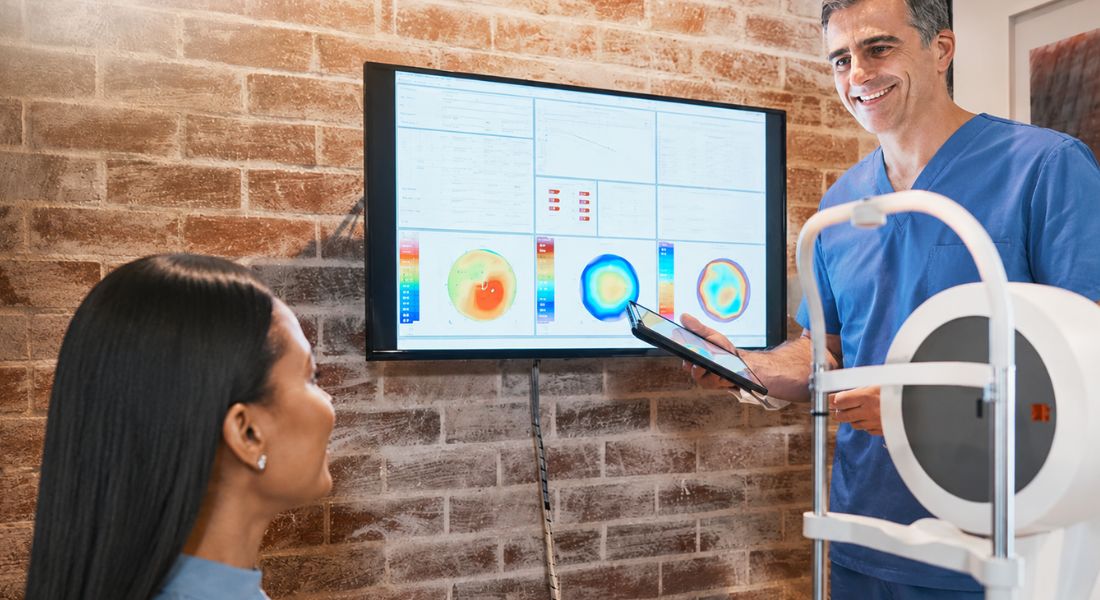
The future of ICL surgery is moving more and more towards personalised planning, where decisions are based on detailed scans of your eye rather than just standard sizing rules. Artificial intelligence is expected to play a growing role in this by helping surgeons interpret complex biometric data and tailor treatment more precisely to each individual eye. This is important because even small differences in eye structure can affect ICL outcomes, and those differences are not always obvious from basic measurements alone.
- AI-Supported Decision Making: AI tools can help surgeons look at multiple measurements at the same time, such as anterior chamber depth, lens position, and corneal shape. Instead of treating each measurement separately, AI can spot patterns across all the data. This can make planning more consistent and may reduce variation between decisions.
- Improved Lens Sizing Accuracy: Choosing the right lens size is one of the most important parts of ICL surgery. AI-based systems may help reduce uncertainty by predicting how different lens sizes are likely to sit inside the eye. This can improve the chances of getting a better fit and reduce the risk of sizing-related issues.
- Better Vault Prediction and Safety Outcomes: Vault refers to the space between the ICL and your natural lens, and it’s a key factor in long-term safety. AI can combine different imaging and biometric data to estimate this more accurately before surgery. This may help lower the risk of complications such as cataract formation or pressure changes.
- Comparison of Lens Options Before Surgery: Personalised planning tools may also help surgeons compare different lens models or sizes before deciding which one to use. This gives a clearer idea of how each option might behave in a specific eye and helps guide more tailored decision-making.
Overall, personalised ICL planning is a big step forward because it recognises that no two eyes are the same. Even if two patients have similar prescriptions, their internal eye structure can be very different. By combining AI with careful clinical assessment, surgeons can make more informed, individualised decisions, leading to safer and more predictable outcomes for patients.
AI for Lens Size Selection
Choosing the correct ICL size is one of the most important parts of surgery planning. Traditional sizing methods often use a limited number of measurements, but they may not capture the full complexity of your eye anatomy.
Machine learning models can use more variables and analyse non-linear relationships between different eye measurements. A 2025 International Journal of Ophthalmology study reported that AI can effectively predict post-operative vault and determine ICL size, with XGBoost performing better than other tested machine-learning methods.
For you, this could help reduce the chance of lens exchange or vault-related concerns after surgery. It may also support more personalised planning, especially when your eye measurements are borderline or more complex.
Deep Learning and OCT-Based Vault Prediction
Optical coherence tomography, often called OCT, can provide detailed imaging of the front structures of your eye. Researchers are now using OCT data with deep learning to predict how the ICL may sit inside the eye after surgery.
A 2025 study on VAULT-OCT reported that an OCT-based deep learning model achieved a high level of accuracy in predicting post-operative ICL vault. Many predictions fell within a clinically acceptable range, which suggests this approach may support more precise planning.
For you, this means future ICL planning may become more image-led and less dependent on older measurement methods alone. Your surgeon would still make the final decision, but advanced imaging and AI may provide extra support for safer lens sizing and vault prediction.
AI and Ultrasound Biomicroscopy
Ultrasound biomicroscopy (UBM) is a really advanced imaging technique that lets surgeons see deeper structures in the front part of the eye. Instead of only looking at surface scans, it uses high-frequency ultrasound to create detailed cross-sectional images. In ICL surgery, this is especially helpful because it gives a much clearer picture of the internal eye anatomy needed for safe and accurate lens placement.
- Role of UBM in Eye Imaging: UBM uses high-frequency sound waves to produce detailed images of internal eye structures that you can’t always see with standard scans. It allows surgeons to look behind the iris and understand the spaces within the front of the eye. When planning ICL surgery, this helps them get a better sense of how the lens will fit before making any decisions.
- AI-Based Vault Prediction Models: A 2025 study looked at how AI combined with biometric data and UBM imaging may improve vault prediction. Vault is basically the space between the implanted lens and your natural lens, and it’s really important for long-term safety. Better predictions can help reduce surprises after surgery and make planning more accurate.
- Improved Personalised Surgical Planning: When AI is used alongside UBM, planning becomes much more tailored to the individual. Instead of relying only on standard measurements, surgeons can look at deeper structural details of the eye. This can help them choose the right lens more accurately, especially in tricky or borderline cases.
- Better Understanding of Internal Eye Space: UBM gives surgeons a clearer view of the exact space where the ICL will sit after surgery. This helps them judge whether the eye anatomy is suitable and whether implantation is likely to be safe. It also makes decision-making more confident in more complex cases.
Overall, combining ultrasound biomicroscopy with AI is a big step forward in ICL planning. It helps surgeons look beyond surface-level measurements and understand the eye in much more detail. The result is more precise planning, better decisions, and potentially safer and more personalised outcomes for patients.
AI-Based Tools for Predicting Postoperative Vault
AI-based tools are being studied to help surgeons estimate vault before ICL surgery. One 2025 study found that ICLGuru reliably predicted post-operative vault with clinically acceptable accuracy across varied clinical settings. This suggests AI may help make ICL planning more consistent and data-led.
This type of tool could support safer pre-operative planning by helping surgeons choose lens size more carefully. It may also help reduce uncertainty when eye measurements are borderline or when anatomy is more complex. For you, this could mean a clearer explanation of why a particular lens size is being recommended.
However, these tools should support clinical judgement rather than replace it. Your surgeon still needs to review your scans, measurements, eye anatomy, eye pressure, and overall suitability before making the final decision. AI may provide useful guidance, but the safest outcome still depends on expert interpretation and careful clinical planning.
Why the Surgeon Still Matters

Even with AI becoming more involved in planning and analysis, the surgeon still plays the most important role. They need to assess your eye health in detail, explain the risks clearly, choose the most appropriate treatment, and decide whether ICL is actually suitable for you. In other words, technology can support the process, but it cannot take over clinical responsibility.
AI also cannot fully understand your personal situation. It does not know your symptoms in context, your lifestyle, your visual expectations, or your concerns about long-term outcomes. These are all important parts of the decision, and they can only be properly discussed during a human consultation. This conversation is what helps tailor treatment to you as an individual.
The safest future is likely to be a combination of both. Advanced data analysis from AI can support planning, while experienced surgeons provide clinical judgement and personal assessment. Together, this balance aims to improve safety, accuracy, and patient confidence in ICL decisions.
Multimodal Deep Learning in ICL Planning
Multimodal deep learning means using different types of data together. In ICL planning, this may include OCT, UBM, biometry, corneal measurements, and patient-specific anatomical details. This gives your surgeon a fuller picture of the eye before surgery.
A 2025 study reported that a multimodal deep-learning model significantly improved post-operative vault prediction and ICL size selection. This is important because no single measurement can fully describe your eye. Different scans and measurements may each show something useful.
For you, this means future ICL planning may become more accurate and personalised. By combining several types of data, AI may help surgeons choose lens size more confidently and reduce uncertainty before surgery.
AI for Shallow Anterior Chamber Cases
Some patients have shallower anterior chambers, which can make ICL planning more complex. This matters because the internal space inside your eye is a key part of deciding whether an implantable lens can sit safely. If there is not enough space, the risk of vault, pressure, or angle-related concerns may increase.
A 2025 study found that code-free AI models showed encouraging performance in predicting vault in patients with shallow anterior chambers. This suggests AI may help specialists analyse more complex eye anatomy with greater detail. It may also support safer lens sizing decisions in cases where traditional measurements are less straightforward.
For you, this does not mean every shallow anterior chamber is suitable for ICL. It means AI may support more careful assessment, but your surgeon still needs to review your scans, eye pressure, drainage angle, lens position, and overall eye health before recommending treatment. The final decision should always be based on safety, not only technology.
AI and Toric ICL Rotation Prediction
Toric ICLs are used when you have myopia with astigmatism. In these cases, lens alignment matters because even small rotation can affect how well the astigmatism is corrected. This can influence the final clarity and sharpness of your vision.
A 2025 study explored AI models for predicting post-operative toric ICL rotation and its effect on refraction and vision. This kind of research may help surgeons understand which eyes are more likely to experience rotation after surgery.
For you, this could support more accurate planning if you need astigmatism correction. AI may help your surgeon choose and position the lens more carefully, but the final decision still depends on detailed measurements, surgical judgement, and follow-up after surgery.
AI and Postoperative Vault Measurement
AI may also help after surgery by measuring vault more consistently. Post-operative monitoring is important because your surgeon needs to confirm that the ICL is sitting safely inside your eye. Vault checks help assess the space between the ICL and your natural lens.
A study on deep learning-based estimation of ICL vault found that AI could accurately measure post-operative vault on anterior segment OCT images. This suggests AI may help make follow-up measurements more consistent and efficient.
For you, this could support safer long-term monitoring after ICL surgery. Your surgeon would still review the results, but AI may help clinical teams track vault more accurately and identify changes that need closer attention.
AI and Anterior Segment Imaging
Anterior segment imaging is central to ICL planning because it helps your surgeon examine the space where the lens will sit. It can show important details about your anterior chamber, natural lens position, angle anatomy, and other structures that affect suitability.
A 2025 review of anterior segment OCT applications notes that AI is being used for vault prediction and ICL sizing. It also explains that machine learning may improve prediction by using broader measurements and analysing complex interactions between them.
For you, this means imaging and AI may work together to create a more personalised surgical plan. Your surgeon can use detailed scans alongside AI-supported analysis to better understand your eye anatomy and choose the safest lens option.
AI and Patient Safety
AI may improve patient safety by helping surgeons avoid abnormal vault, poor sizing, or unsuitable lens selection. This matters because vault-related problems may require extra monitoring or, in some cases, lens exchange after surgery.
The 2025 TVST study on AI vault prediction stated that AI could reduce abnormal post-operative vault and improve ICL implantation safety. This suggests AI may help make planning more accurate and reduce avoidable risks.
For you, AI may become a useful safety-support tool during ICL planning. It should not replace your surgeon’s judgement, but it may give your specialist more detailed information to support safer lens selection and long-term outcomes.
AI and Surgical Outcome Prediction
AI may also help predict outcomes beyond vault. In the future, it may support predictions around visual quality, refractive accuracy, toric lens alignment, patient satisfaction, and long-term stability. This could give surgeons a broader view of what to expect before surgery.
For you, this may lead to more realistic counselling before ICL treatment. Your surgeon may be able to explain not only whether ICL is suitable, but also what results are more likely based on your eye measurements and risk profile. This could make the decision-making process clearer.
AI may also help identify patients who need closer follow-up after surgery. The goal is not just better surgery. It is better expectation-setting, safer planning, and clearer decisions for each patient.
AI and Workflow in ICL Clinics
AI may help clinics organise and interpret large amounts of pre-operative data. This can include scans, measurements, lens calculations, risk factors, and predicted outcomes. When used carefully, it may help make ICL planning more structured and consistent.
A 2025 article on AI and digital tools in cataract and refractive surgery describes how AI may improve pre-operative planning, workflow, accuracy, and patient-facing tools. This means AI could support both clinical decision-making and the way information is explained during your consultation.
For you, this may make the consultation process clearer and more organised. However, it should never make care feel rushed or automatic. Your surgeon should still take time to explain your results, answer your questions, and make decisions based on your full eye assessment.
The Limits of AI in ICL Surgery
AI has promise in ICL surgery, but it also has limits. It depends on the quality of the data used to train it, the patient population studied, and the accuracy of the measurements entered. If the input data is limited or inaccurate, the prediction may also be less reliable.
A model that performs well in one setting may need further validation before being used widely in another. This is especially important because eye anatomy can vary between patients and populations. What works well for one group may not automatically apply to every patient.
For you, this means AI should be seen as a support tool, not a replacement for specialist judgement. Your surgeon still needs to interpret the results, check your eye anatomy carefully, and make the final decision based on your full assessment.
The Future of AI in ICL Surgery
The future of AI in ICL surgery is expected to focus on vault prediction, lens sizing accuracy, toric alignment prediction, anterior segment modelling, risk detection, and post-operative monitoring. These tools may help surgeons plan ICL procedures with greater precision and make decisions in a more data-led way.
Research from 2025 suggests that AI and machine learning are already starting to support vault prediction and lens sizing decisions. This may help reduce uncertainty before surgery, especially when small measurement differences can affect the final outcome.
AI is expected to support clinical judgement, not replace it. Your surgeon’s experience will still remain essential, but AI may provide extra guidance through detailed analysis and prediction tools. For you, this could mean more personalised planning, safer decision-making, and more predictable ICL outcomes over time.
What AI Means for Patients Considering ICL

If you are considering ICL surgery in London, AI may increasingly become part of how your treatment is planned in the future. It can help with lens sizing, vault prediction, risk assessment, and follow-up monitoring. In simple terms, it acts as an extra support tool for surgeons during planning.
However, the key question for you still remains the same: is ICL suitable for your eyes? A proper consultation should include detailed imaging, eye pressure checks, endothelial cell assessment, prescription review, retinal examination, and a clear discussion of all suitable options. These steps are essential for making a safe and informed decision.
AI may support the process, but it cannot replace careful clinical judgement. Your surgeon still needs to assess your individual eye health and overall suitability. The final decision will always depend on a full clinical evaluation, not technology alone.
FAQs:
- What is ICL surgery?
ICL surgery involves placing an implantable collamer lens inside your eye to correct vision. Unlike LASIK or PRK, the procedure does not reshape the cornea. The natural lens remains in place during treatment. - How is artificial intelligence being used in ICL surgery?
Artificial intelligence is being studied to help improve ICL planning, especially for lens sizing, vault prediction, anterior segment imaging analysis, and postoperative monitoring. AI may help surgeons make more personalised treatment decisions. - What is vault in ICL surgery?
Vault refers to the space between the implanted ICL and your natural lens. Maintaining a safe vault is important because very low or very high vault measurements may increase the risk of complications. - Why is AI useful for vault prediction?
AI can analyse complex eye measurements and identify patterns that may improve vault prediction accuracy. This may help surgeons choose a more suitable lens size before surgery. - Can AI replace the surgeon in ICL surgery?
No. AI is designed to support clinical decision-making, not replace the surgeon. The surgeon still needs to assess your eye health, explain risks, review alternatives, and decide whether ICL is suitable for your eyes. - What imaging scans are used in AI-assisted ICL planning?
AI-assisted ICL planning may use imaging methods such as anterior segment OCT, ultrasound biomicroscopy (UBM), corneal imaging, and biometry measurements to assess the internal structure of the eye. - How could AI improve patient safety in ICL surgery?
AI may help reduce the risk of abnormal vault, incorrect lens sizing, or unsuitable lens selection by improving the accuracy of pre-operative planning and prediction models. - Can AI help with toric ICL surgery for astigmatism?
Yes. Research is exploring whether AI can help predict toric ICL rotation and improve astigmatism correction accuracy after surgery. - Will AI make ICL surgery fully automated?
Current research focuses on supporting surgical planning and monitoring rather than fully automating the procedure. Human clinical judgement, surgical skill, and patient assessment remain essential. - What does the future of AI in ICL surgery look like?
The future of AI in ICL surgery is likely to involve better vault prediction, improved lens sizing, more personalised planning, enhanced imaging analysis, automated monitoring, and stronger long-term safety assessment.
Final thought: AI in ICL Surgery and Patient Care
Artificial intelligence is steadily shaping how ICL surgery is planned, analysed, and followed up, particularly in areas such as vault prediction, lens sizing, anterior segment imaging, and postoperative monitoring. The evidence from recent research suggests that AI can enhance accuracy by identifying patterns in complex eye measurements, helping surgeons refine decisions that were traditionally based on more limited datasets.
For you, this means ICL planning is moving towards a more data-informed and personalised approach. However, AI works best as a support tool rather than a replacement for clinical judgement. A thorough assessment is still essential, including detailed eye scans, endothelial cell evaluation, eye pressure checks, and a full review of your visual needs and long-term eye health.
The future of ICL surgery is likely to combine advanced AI-driven prediction models with experienced surgical expertise. This balance aims to improve safety, reduce uncertainty in lens selection, and deliver more predictable visual outcomes for suitable patients. If you’re considering ICL surgery in London and want to know if it’s the right option for you, you’re welcome to reach out to us at Eye Clinic London to book a consultation.
Reference:
- Zhang, Y. et al. (2025) EVO-ICL vault prediction: a data wrangling framework integrating multicenter big data and machine learning. Available at: https://pubmed.ncbi.nlm.nih.gov/41090992/
- Shen, Y. et al. (2023) Big-data and artificial-intelligence-assisted vault prediction and EVO-ICL size selection for myopia correction, 107(2), pp. 201-206. Available at: https://pubmed.ncbi.nlm.nih.gov/34489338/
- Li, X. et al. (2025) EVO-ICL vault prediction: a data wrangling framework integrating multicenter big data and machine learning, 15(1), pp. 427-441.Available at: https://pmc.ncbi.nlm.nih.gov/articles/PMC12882899/
- Xiao, Y. et al. (2024) Comparison of pain between bilateral ICL surgeries in patients with myopia, 24, 175. Available at: https://pmc.ncbi.nlm.nih.gov/articles/PMC11022364/
- Alfonso, J.F., Lisa, C., Fernández-Vega, L., Almanzar, D., Pérez-Vives, C. and Montés-Micó, R. (2015) Prevalence of cataract after collagen copolymer phakic intraocular lens implantation for myopia, hyperopia, and astigmatism, 41(4), pp. 800–805. Available at: https://www.sciencedirect.com/science/article/pii/S0002939421000684