


RayOne Galaxy Lens: What Is It and What Makes the New Spiral IOL Different?
If you have been researching cataract surgery or refractive lens exchange recently, you may already have come across the RayOne Galaxy lens.
It is one of the newest generations of premium intraocular lenses and has attracted considerable attention because it uses a very different optical concept from conventional multifocal and trifocal lenses.
But what exactly is a Galaxy lens? How does a spiral optic work? And, perhaps more importantly, what might it mean for your vision?
Mr Samer Hamada, Consultant Ophthalmic Surgeon and Medical Director of Eye Clinic London, explains.
What is the RayOne Galaxy lens?
RayOne Galaxy is a premium intraocular lens manufactured by the British ophthalmic company Rayner.
It can be implanted during cataract surgery or refractive lens exchange (RLE), replacing the eye’s natural lens with an artificial lens designed not only to restore clear vision but also to provide a broad range of focus.
Galaxy was introduced by Rayner as the world’s first intraocular lens to use its proprietary spiral optical design, developed with the assistance of artificial intelligence. Unlike traditional diffractive multifocal lenses, which divide incoming light between defined focal points, Galaxy uses a continuous spiral refractive structure intended to create a smoother range of vision.
The objective is straightforward: to give suitable patients useful distance, intermediate and near vision, while reducing some of the optical compromises historically associated with multifocal lens technology.
What is different about the Galaxy spiral optic?
The easiest way to understand the difference is to think about how a lens creates focus.
A traditional monofocal lens is primarily designed to create one main focus, usually for distance.
A trifocal lens uses different optical zones or diffractive structures to create distinct focal points for distance, intermediate and near vision.
Galaxy takes another approach.
Its spiral refractive surface has been designed to create a continuous progression of focus, rather than three completely separate focal points. Rayner describes the design as non-diffractive and reports that the optic was developed using an AI-based design process trained around visual-performance parameters.
For patients, the technology itself matters less than the question it is attempting to solve:
Can we give a patient a broad range of vision without creating excessive optical side effects?
That is one of the most important questions in modern premium lens surgery.
Is Galaxy a multifocal lens?
Patients will often hear Galaxy described as a multifocal lens because its purpose is similar: reducing dependence on glasses at multiple distances.
Technically, however, its optical design is different from the conventional diffractive multifocal or trifocal lenses that have been used for many years.
Galaxy is better described as a full-range-of-vision spiral intraocular lens.
The distinction matters because different optical designs distribute light differently and can therefore behave differently in terms of contrast, range of focus, halos and glare.
What vision can the Galaxy lens provide?
The goal of Galaxy is to provide useful vision across the visual range:
- distance vision, such as driving or watching television;
- intermediate vision, including computer screens and dashboards;
- near vision, including phones, menus and many everyday reading tasks.
A peer-reviewed multicentre clinical study published in the Journal of Refractive Surgery evaluated Galaxy patients three months after bilateral implantation. The study reported a smooth binocular defocus curve and good visual acuity across distance, intermediate and near ranges.
This is encouraging, but it is important to understand that no intraocular lens guarantees complete spectacle independence for every patient or every task.
Very small print, prolonged reading, dim lighting or particularly demanding visual activities may still require glasses in some individuals.
Does Galaxy cause halos or glare?
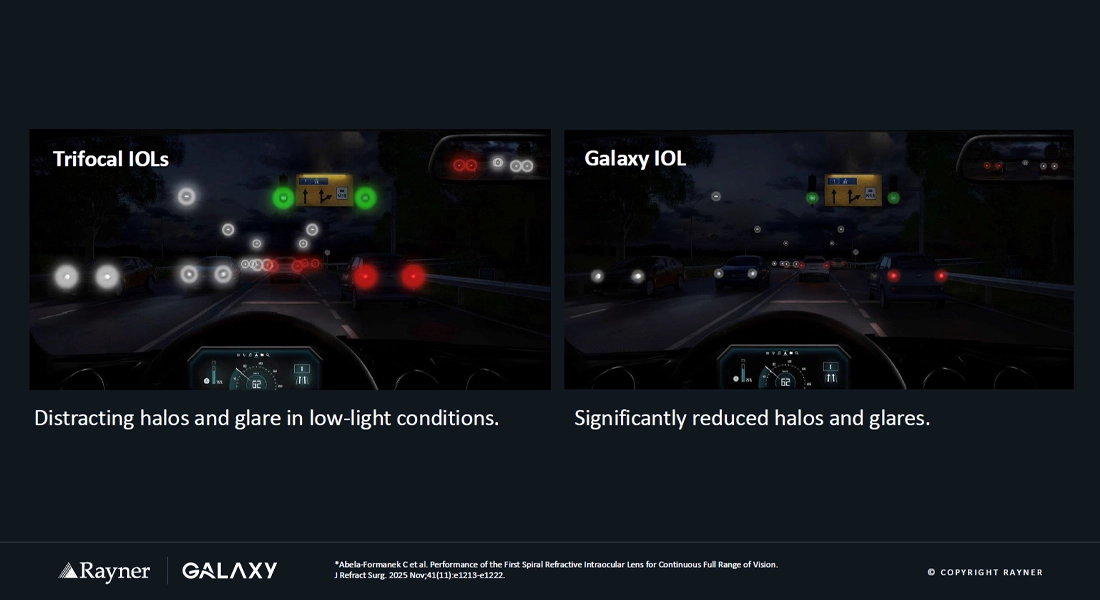
This is one of the questions patients ask us most frequently.
Any lens that attempts to create a wider range of focus can potentially produce optical phenomena such as halos, glare or starbursts, particularly during the early period after surgery.
The interesting aspect of Galaxy is that its non-diffractive spiral design was specifically developed with visual quality and dysphotopsia in mind.
In the first peer-reviewed Galaxy clinical study, more than 95% of the reported halo and glare symptoms were categorised as minor, with no severe symptoms reported in the study population. Preclinical testing in the same publication also found less halo and glare with Galaxy than with the diffractive trifocal lens used for comparison.
That does not mean halos cannot occur.
Every patient’s eye, pupil, cornea, tear film and visual system is different. Neuroadaptation also plays an important role following any presbyopia-correcting lens implantation.
This is why realistic counselling before surgery is as important as the lens itself.
What about astigmatism?
RayOne Galaxy is also available in a Galaxy Toric version for patients with clinically significant corneal astigmatism. Rayner launched the standard and toric Galaxy platforms together.
Correcting astigmatism accurately is particularly important when implanting a premium lens because even relatively small residual refractive errors can reduce the quality of vision a patient experiences.
Detailed corneal measurements and accurate biometry are therefore essential before deciding whether a toric Galaxy lens is appropriate.
Is Galaxy suitable for cataract surgery and lens replacement?
Yes.
Galaxy may be considered in two main situations.
Cataract surgery
When the natural lens becomes cloudy, it is removed and replaced with an intraocular lens. Patients can choose different categories of replacement lens depending on their eye health and visual priorities.
Refractive lens exchange
In RLE, the natural lens is replaced before a visually significant cataract has developed, usually because a patient wishes to reduce dependence on glasses for distance and near vision.
The operation itself is closely related to modern cataract surgery, but the expectations of an RLE patient are often considerably higher. Careful patient selection is therefore particularly important.
Is the newest lens automatically the best lens?
No.
This is probably the most important point to understand.
Modern cataract and refractive surgery now gives us an extraordinary range of intraocular lenses: monofocal, enhanced monofocal, EDOF, trifocal, toric and full-range lenses such as Galaxy.
That does not mean one lens is universally better than every other lens.
At Eye Clinic London, we choose the lens for the eye — not the eye for the lens.
Before recommending a premium intraocular lens, Mr Hamada considers the health and shape of the cornea, ocular surface, macula, optic nerve, pupil characteristics, astigmatism, previous eye surgery and, crucially, how the patient actually uses their vision.
A patient who spends all day working on screens may have different priorities from somebody who drives extensively at night. Someone who reads fine print for many hours may have different needs from someone whose principal objective is excellent distance and intermediate vision.
The conversation therefore starts with the patient, not with the name printed on the lens box.
Mr Samer Hamada and the RayOne Galaxy lens
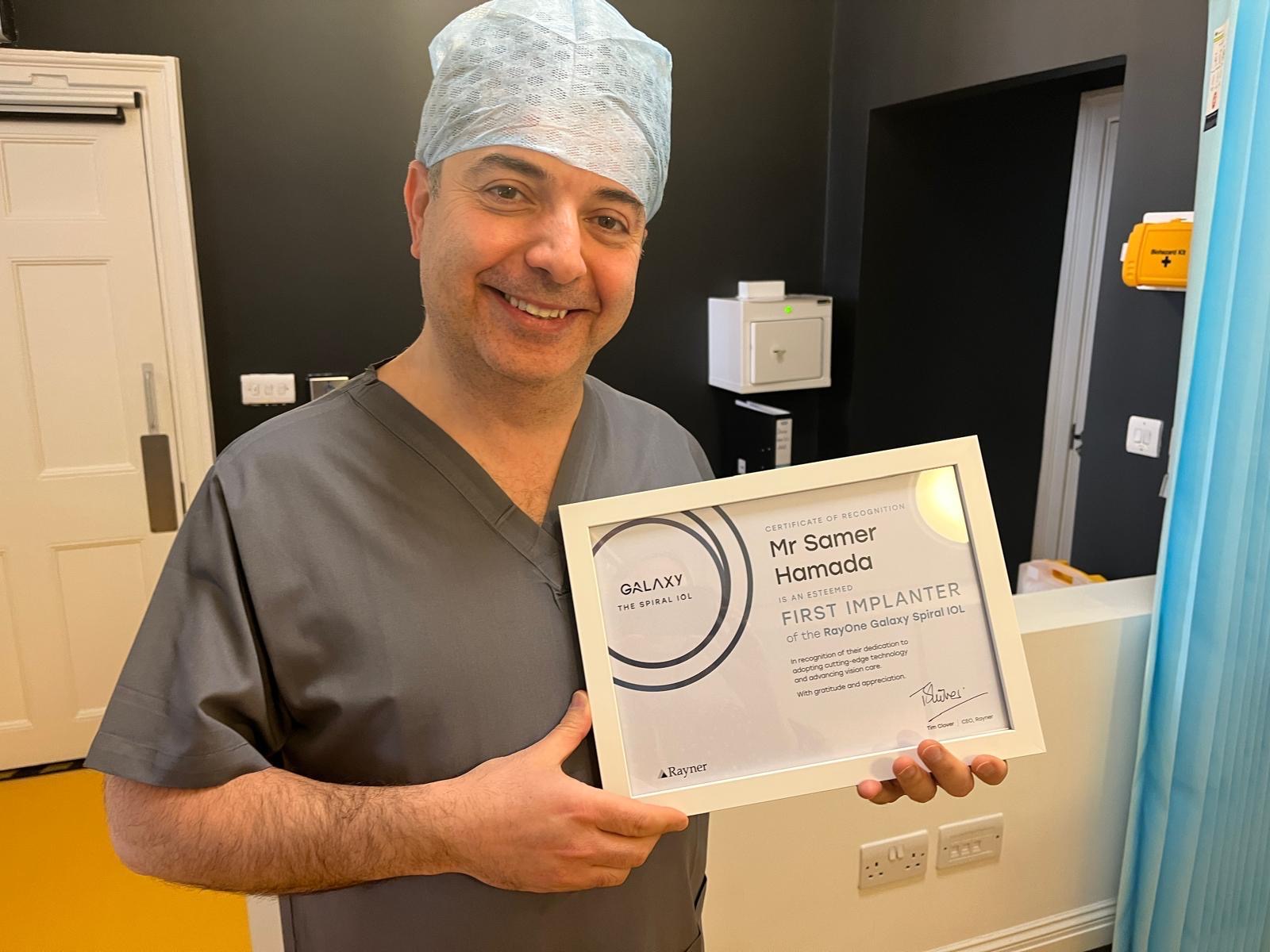
Mr Samer Hamada was among the early surgeons to implant the RayOne Galaxy lens and was recognised by Rayner as an early Galaxy implanter.
As a consultant corneal, cataract and refractive surgeon with more than 25 years of ophthalmic experience, his particular interest is not simply in implanting premium lenses but in matching modern optical technology to the individual eye.
This is particularly relevant in patients with ocular surface disease, previous refractive surgery, corneal abnormalities or demanding visual requirements, where lens selection cannot safely be based on a standard formula.
At Eye Clinic London, Galaxy is therefore one option within a wider portfolio of advanced intraocular lenses rather than an automatic recommendation.
So, is Galaxy right for you?
Galaxy represents an exciting development in premium intraocular lens technology.
For the right patient, its combination of distance, intermediate and near vision and its non-diffractive spiral optical concept may make it an attractive option for cataract surgery or refractive lens exchange.
The more important question, however, is not:
“Is Galaxy a good lens?”
It is:
“Is Galaxy the right lens for my eyes and the way I want to see?”
That decision requires detailed diagnostics, careful discussion and an understanding of the compromises as well as the potential benefits of each lens technology.
At Eye Clinic London in the Harley Street medical district, Mr Samer Hamada provides personalised assessment for patients considering RayOne Galaxy and other premium lens options.
References
Abela-Formanek C, et al. Performance of the First Spiral Refractive Intraocular Lens for Continuous Full Range of Vision. Journal of Refractive Surgery, 2025.
Rayner. Rayner announces launch of world’s first spiral IOL designed with AI. 2024.